Broken chains
On July 1st we celebrated the end of slavery in Suriname and the former Dutch Caribbean colonies, effectively 150 years ago. The remembrance day is called Keti Koti, Surinamese for Broken Chains.
King Willem Alexander of the Netherlands formally apologised for slavery and for the role his royal forebears played in the slave trade. On June 30, prior to the celebration, I attended a ceremony in the monumental St Bavo church in Haarlem, where recently the grave of a Surinamese woman was re-discovered. Susanna Dumion was taken from Suriname to Holland as an enslaved woman by her owner in 1753. She lived to a great age and passed away in 1818, 105 years old! Her life was investigated 200 years later, which finally gave back an unknown woman her Afro-Surinamese identity.
Mariska de Jong, Chairwoman of the Haarlem branch of the Slavery Remembrance Committee in this country, is writing a book on Susanna Dumion’s life.
 |
| A wreath is laid on Susanna's grave |
Identity is a key word in slavery, as one of the effects of slavery was the denial of identity in
people who strongly leaned on the oral tradition of their forebears. The connection
with their African past was brutally cut off, which not only harmed the people
themselves, but also the communities they came from.
Disrupted societies
Recently, Dutch historian and author Martin Bossenbroek was interviewed on TV following publication of his new book De Zanzibar Driehoek (The Zanzibar Triangle, not yet available in English), about the slave trade on the African east coast. At some stage he mentioned the disruption of traditional African communities due to many centuries of slave trade. It set me wondering: could this disruption be linked to the present-day migration tide into Europe?

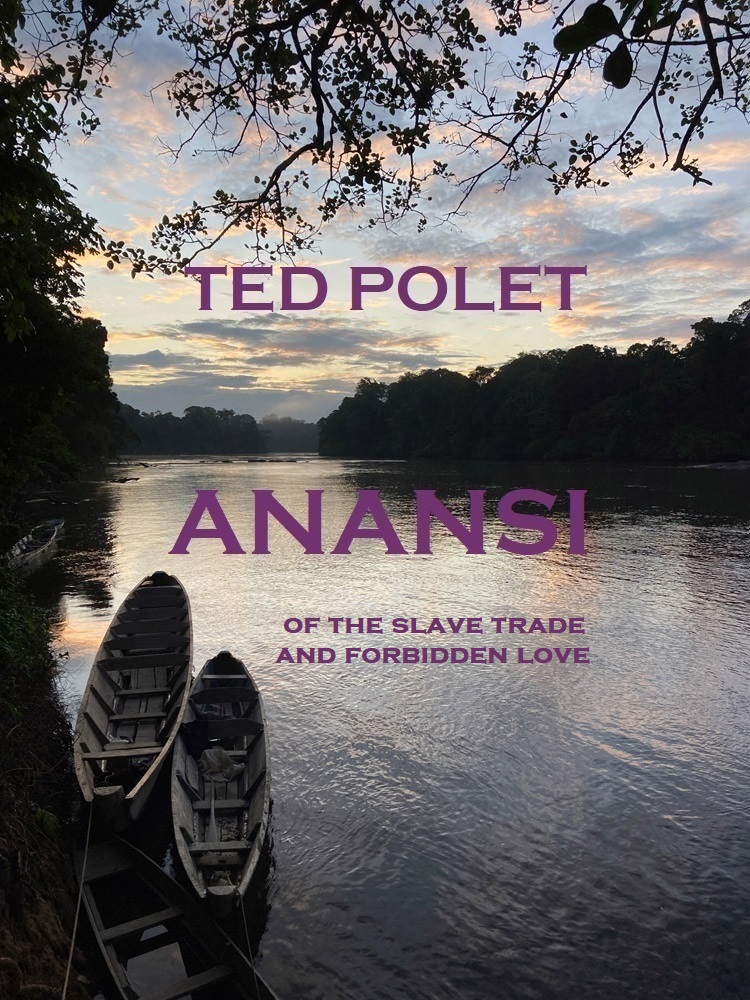
I wrote several novels, of which The Batavian is set against the background of migration in the Mediterranean. My latest book Anansi is an historical novel with the slave trade as its background theme. So naturally I wondered about a possible connection between the slave trade and present-day migration, and started an investigation of my own.
Dehumanisation is of all ages
Enslaved people and the indigenous population of colonial areas weren’t seen as people with their own feelings and dreams. They were commonly described as stupid, without morals or character, denying them their identity and culture. This ineradicable attitude took root in the minds of plantation owners and slave traders and eventually became a common opinion in western minds. Even though the tide is turning, we still see the consequences today: open or hidden discrimination.
 |
| arrival of a slave ship |
The parallel with present-day treatment of migrants cannot be denied. Rejecting their own culture and values, the humiliating treatment before we allow them into our country. The pushbacks to sea of the virtual wrecks in which they arrive on our coasts, refuting all international treaties.
 |
| the deadly routes to Europe (source: NOS) |
The way migrants are being dehumanised cannot be shown more clearly than in an article which I found in the Dutch press. When another of these unseaworthy boats full of migrants founders at sea, the victims are buried in anonymous graves, without bothering to find out who they were. Their families are left in uncertainty about their fate. I’m afraid the article is in Dutch, but here it is:
The article concludes as follows: It is an obligation we have as human beings to one another, but especially in Europe as a community. Even if we do not want them here, then let us at least show them respect by giving them a name and a face.
Africa is shackled to the
past
Let us focus on Africa for a moment, even
though migration isn’t only an African thing. According to Marie-Laurence
Flahaux and Hein De Haas (2016), poverty in itself isn’t the only cause of
migration, as is often assumed. If you are too poor, you cannot even travel. But
poverty lies at the base of migration all the same. As soon as the mean income
of a region increases by a tiny margin, people are seen to take to the road to
find a better life elsewhere. They are condescendingly called ‘fortune seekers’
over here, as if that is a bad thing. I am a fortune seeker myself, and you,
dear reader, probably as well.
https://comparativemigrationstudies.springeropen.com/articles/10.1186/s40878-015-0015-6
Poverty and violence are
the cause of a great deal of migration even inside Africa, and Africa itself knows closed borders
not unlike the European outer boundary. It is a universal control reflex of
authorities.
Looking at a study by Nathan Nunn (2007) of the lack of economic development in Africa, it appears that 20 years ago (it is an old study) the mean yearly income in Africa was about 40% of the income in other developing countries. In some countries it is slowly improving now, but that apparently only fuels migration.
 |
| Jamestown, Accra, 2012 |
What surprised me, and now we are looking at the link to the slave trade, is that according to Nunn the lack of economic prosperity in Africa is greatest in regions where the slave trade was strongest!
Are we finally being presented with the bill?
So perhaps I’m jumping to conclusions, but we might say that Europe is now being presented with the bill of the slave trade from the past, as the Africans from regions destitute through the former slave trade, who are now marginally able to pay a human trafficker, are now knocking on our door.
https://scholar.harvard.edu/nunn/files/hup_africa_slave_trade10.pdf
(Nathan Nunn)
Apart from the economic angle, there is another effect. In some areas of Africa, mutual distrust between people, and mistrust of authorities is rife. Authorities are seen as the enemy, which doesn’t really surprise me. And it has an effect on behaviour of people during migration, where they are confronted with authorities bent on making life difficult for you. It may even have an effect on the death rate during migration.
The interesting thing is that Nunn has found that distrust also is a legacy of the slave trade: there is more distrust amongst people in areas ravaged most by the slave trade.
https://dash.harvard.edu/bitstream/handle/1/11986331/nunn-slave-trade.pdf
(Nathan Nunn)
Finally
I know a Ghanaian family who have managed to put one of their sons through University. That young man now has a certificate of his ICT training, but finding a job in Africa depends on having influential friends. He is working hard to find a job, but meets with little success. Such young people are greatly at risk to end up as a migrant on the shores of Europe.
Do I have a fitting solution? I haven’t studied international relations or whatever qualification is needed to find a solution. But my common sense says this must be solved at the source. Closed borders, pushbacks and dirty deals with dictatorial governments will not hold back the tide of migrants. So don’t bribe dictators to act as gatekeepers for Europe, but invest in working opportunities and equal prospects for everyone in Africa. Eventually that will put the brakes on migration, human trafficking and deaths at sea.
On
July 1st, 2023, we looked back in horror on the days of slavery. But
did we learn the lessons from the past? Will there not be a need for more
excuses by governments, 150 years from now, when our descendants look back with
horror on the way Europe now deals with migrants?