Monday, 16 October 2023

An eye for an eye

History repeats itself

Writing isn’t always fun, as the title of this blog implies. Up to now I didn’t want to write of the new Gaza war, because there are no words to describe the mutual cruelties being inflicted. But perhaps it is good to try and learn from history - an essential task for an author. Many years ago, I experienced some Middle Eastern history at close quarters.

Yom Kippur 1973

Exactly 50 years ago, I arrived in the Middle East in a Dutch cargo vessel, shortly after the Yom Kippur war, in which Israel was surprised by an invasion on two fronts from Syria and Egypt, and barely managed to save its skin.

My ship, the mv Oostkerk, prior to departure from Rotterdam in June 1973


The (then) Dutch Defense Minister Henk Vredeling secretly supplied arms to Israel, even without telling his boss, Prime Minister Joop den Uyl. When Vredeling blabbed on TV, naturally the Arabs were furious and imposed an oil boycott against Holland. And my ship was boycotted when we arrived in Latakia, Syria. We barely escaped unharmed. 

Three quarters of our cargo, which came from India and Sri Lanka, was destined for Lebanon, Syria and Libya. Having discharged some cargo in Barcelona, Marseilles and Genoa (where I celebrated my 22nd birthday), we continued to Beirut, still uncertain about the situation awaiting us. Halfway between Crete and Cyprus we passed a US Navy force which included an aircraft carrier.

Our Third Mate plotted large forbidden areas in the chart of the Levant, war zones full of minefields - there were only ‘safe’ corridors to Beirut and Latakia. At the time they were still fighting on the Golan heights.
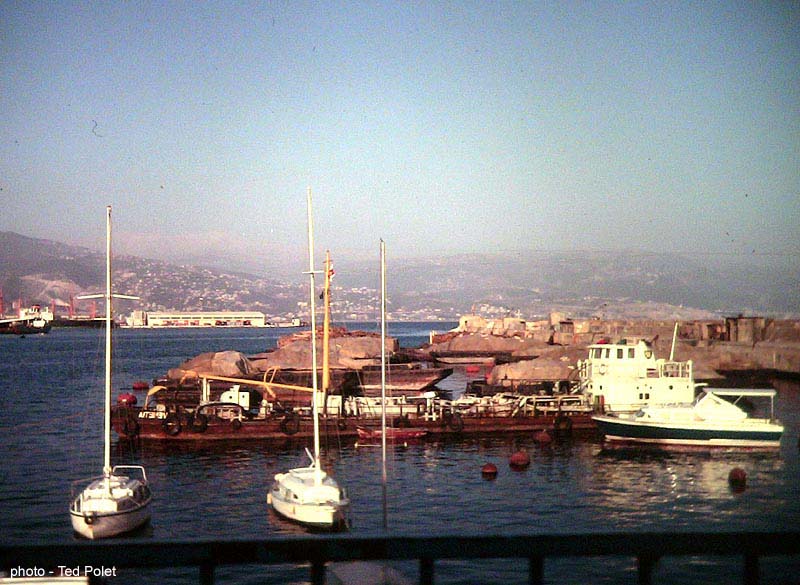
Beirut, November 1973. It still looks peaceful, but tension in the city could be felt and civil war was about to break out.


We cranked the lifeboats outboard, ready for launching in their old-fashioned davits, and closed our only watertight door, that between the engine room and the propeller shaft tunnel. It was clear that we were headed for a war zone. How it ended can be read in my website:

https://www.tedpolet.com/epages/zv08.htm

It could be a theme for a new book - perhaps it will appear at some stage...

An eye for an eye

50 years hence, following intifadas, continous rocket attacks, terrorism and cruel border wars, now we have seen a gruesome attack by Hamas in the south of Israel, followed by an equally gruesome retaliation war started by the Israelis, who are effectively carpet bombing a densely populated area to get at Hamas terrorists sheltering under the city. The scale of cruelty is mind-boggling, with thousands of dead on either side.

Who wants to understand the source of this conflict, should go back to the flight of hundreds of thousands of Palestinians from their lands in 1947-1949. Many were driven out by violence and terror by the newly formed State of Israel. An horrible example is the Deir Yassin massacre in 1947, perpetrated by Israeli murder squads, one of which (the Irgun) was commanded by Menachem Begin, later Prime Minister of Israel. Others left at the invitation of neighbouring Arab countries, who at the time may have thought to benefit from it. The Palestinians still refer to this as the Nakba, the disaster. Nowadays we’d call this ethnic cleansing, a word some people won’t thank me for. If you object, then please point out the difference to me. What’s in a name.

Following WW1, Syria, Lebanon and Palestine were designated a mandate area to be administered by the French and the British. In those days, urged by the Zionist movement and supported by the British (the Balfour Declaration), migration began of the Jewish diaspora to the Promised Land. And inevitably, soon the first tensions developed between the Jewish colonists and the Palestinian locals, who naturally viewed the colonists as invaders. When the British eventually put the brakes on immigration, Zionist militants turned on them.

Should we refuse the Jews a safe country, after having been ravaged by pogroms and the holocaust? Should we refuse the Palestinians a safe country of their own? Whoever has the answer, please tell me. The two sides are entrenched against one another, each held hostage by ideology and bitter hatred fed by a century of violence.

the results of a 1948 car bomb set off by Arab militants in Ben Yehuda Street, Jerusalem.


The two-state solution, once advocated to return to the Palestine people at least part of their ancestral lands, probably is the only possible compromise. But how to get two uncompromising parties back at the negotiating table? 

The theft of land, the de-humanisation and aggression by Jewish colonists in the Israel-occupied territories has continued for decades, feeding the monster of terrorism at the other side. 

Meanwhile, foreign powers such as Iran, Russia, Qatar, Saudi Arabia and the United States are stoking the fire relentlessly, each with their own agenda.

The Norwegian cartoonist Morten Morland drew this appropriate image of Netanyahu hitting Gaza, as ayatollah Khamenei blows out the match he used to light the fire. Note the tiny image of a woman and child fleeing, silhouetted on the hillside.


I will not take sides, even though Western politicians fall over each other to express their support for Israel, ignoring the devastating retaliation war that is being waged by the Israelis against the terrorism of Hamas and similar groups. An eye for an eye - the spiral of revenge will never come to an end. It isn’t just Israeli children, but also Palestinian children who have a right to live. 

All that remains for me is to express deep regret and sympathy with all the thousands of innocents to both sides, who once again fell victim to this almost insolvable conflict.

Additions and corrections November 4th
 
The conflict is even more complicated than I realised at first, as the political situation in the Middle East is marked by wide-spread distrust within the Muslim world.
 
Hamas is connected with the Sunni Muslim Brotherhood. The Hamas leadership hides itself in Qatar, which has for years vied for power with Saudi Arabia. A probable cause for the 7 October attacks by Hamas on Israel is the overtures made by the Saudis to Israel, which apparently have now ceased. 
 
In Qatar talks are going on between Hamas and the Iranian Foreign Ministry - apparently a pact is being forged against a common enemy.

blood on their hands: talks in Qatar between the Iranian Foreign Minister and the Hamas leader Ismail Haniyeh, October 14 (source: CBC News.)


Hezbollah, which is based in Lebanon, is a Shiite group supported by Iran and Syria. Even though they are fighting Israel, they haven't deployed their full power, possibly under American threat. 
 
Meanwhile, the death toll in Gaza passed the 20,000 mark, 8000 of whom are innocent children, as opposed to 1139 Israeli victims (corrected numbers 1/1/24). All proportion is gone from the Israeli retaliation. When will there be an end to the violence caused by the war-mongering leadership to both sides? The Netherlands refused to demand a cease-fire and refrained from voting in the UN. What a disgrace. Meanwhile, the world looks on in horror


Monday, 2 October 2023

A summary of my books


Up to now I haven’t done a great deal of promoting the English editions of my books, so to make a start, I decided to give you an overview. My books were originally written and published in Dutch. 
 
ANANSI, TWO FATHOMS DEEP, THE CARGO and THE BATAVIAN are now available from Amazon, in paperback and Kindle e-book format. They were also released for general availability through booksellers and can be ordered using the ISBN and the title. I will now give a short description of each book, including a link to an extract and a video trailer.


ANANSI

ISBN: 9798395461148


ANANSI (2023) is an historical novel set against the slave trade and the Surinamese plantations at the end of the 17th Century. It is the story of the forbidden love of an enslaved woman and a Dutch sailor, who against all odds and the harsh reality of the slave trade hold on to one another, hoping for a better life in freedom. The tale begins in fort Elmina, the headquarters of the Dutch West India Company in what used to be the Gold Coast (Ghana today). It then moves across the Atlantic, ending up in the colony of Suriname shortly after the Dutch take-over in the late 17th Century.

The main protagonists are Efua, a young African woman enslaved by a Spanish slave trader based in Elmina, and a rebellious Dutch sailor, who feel irresistibly attracted to one another. The forbidden liaison comes to light and the girl is sold and put aboard a slave ship to Suriname. The young man manages to talk himself on board another ship to go and search for her on the other side of the Atlantic, a search full of hardship in the South American jungle.

ANANSI is a gripping tale of the Dutch slave trade and the horrors of the Surinamese plantations, about Caribbean pirates, hurricanes and the deprivations of seafaring in times long gone. The folk tales of the spider and smart trickster Anansi, which in West Africa are related by the elders to the younger generation, travelled to Suriname with the slave trade, and are at the core of the book. Efua tells the stories she learned from her grandmother and takes them with her on the slave ship to Suriname.

click for an extract from the book

Videotrailer for ANANSI:


TWO FATHOMS DEEP

ISBN: 9798509954160


What happened to the cargo of the French brig-of-war 'Arabelle', which lay hidden under the sand for two hundred years?

TWO FATHOMS DEEP (2022) is the story of the wreck of the French brig-of-war 'Arabelle' of Napoleon's day, which lay two fathoms below the sand off the isle of Ameland for two centuries. A young man and his girlfriend, who is a descendant of a survivor of the disaster, find enigmatic documents in the legacy of her deceased grandmother.

The personal logbook of a soldier from Napoleon's army gives them a clue to the position of the wreck. Shortly after its discovery the valuable cargo in the wreck is pillaged by ruthless salvage hunters who leave a trail of violence behind. The plot moves from the Dutch coast to the Medway and the Essex rivers.

TWO FATHOMS DEEP is an historical novel that culminates in a contemporary thriller. The wreck and family ties are wrought into a surprising link over the centuries.

click for extract from manuscript

Videotrailer for Two Fathoms Deep:


THE CARGO

ISBN: 9798859000036


THE CARGO (2020, revised 2023) is a thriller of ordinary people caught in woman trafficking.

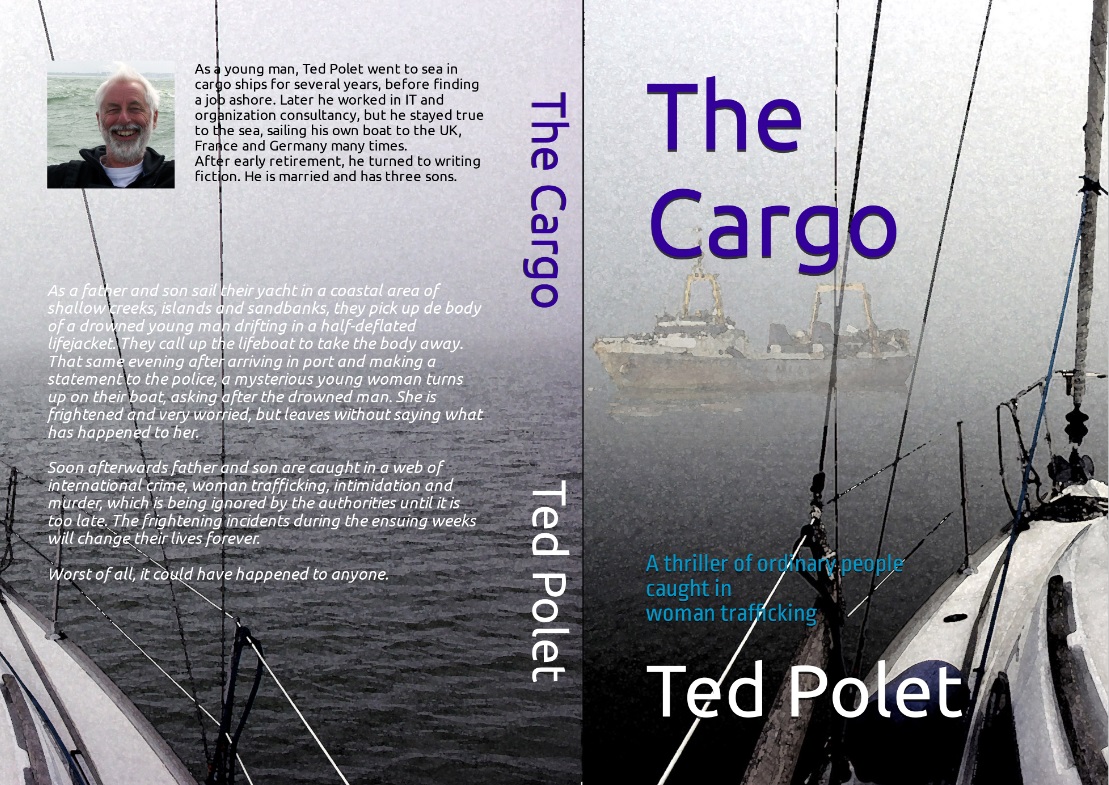
As a father and son sail their yacht in a coastal area of shallow creeks, islands and sandbanks, they pick up de body of a drowned young man drifting in a half-deflated lifejacket. That same evening after arriving in port and making a statement to the police, a mysterious young woman visits their boat, asking after the drowned man.

Soon afterwards they are caught in a web of international crime, intimidation and murder, which is being ignored by the authorities until it is too late and more bodies turn up. The frightening incidents during the ensuing weeks will change their lives forever.

click for extract from manuscript

Videotrailer for The Cargo:


THE BATAVIAN

ISBN: 9798858992837


THE BATAVIAN (2019, revised 2023) is a gripping story of the refugee crisis in the Eastern Mediterranean.

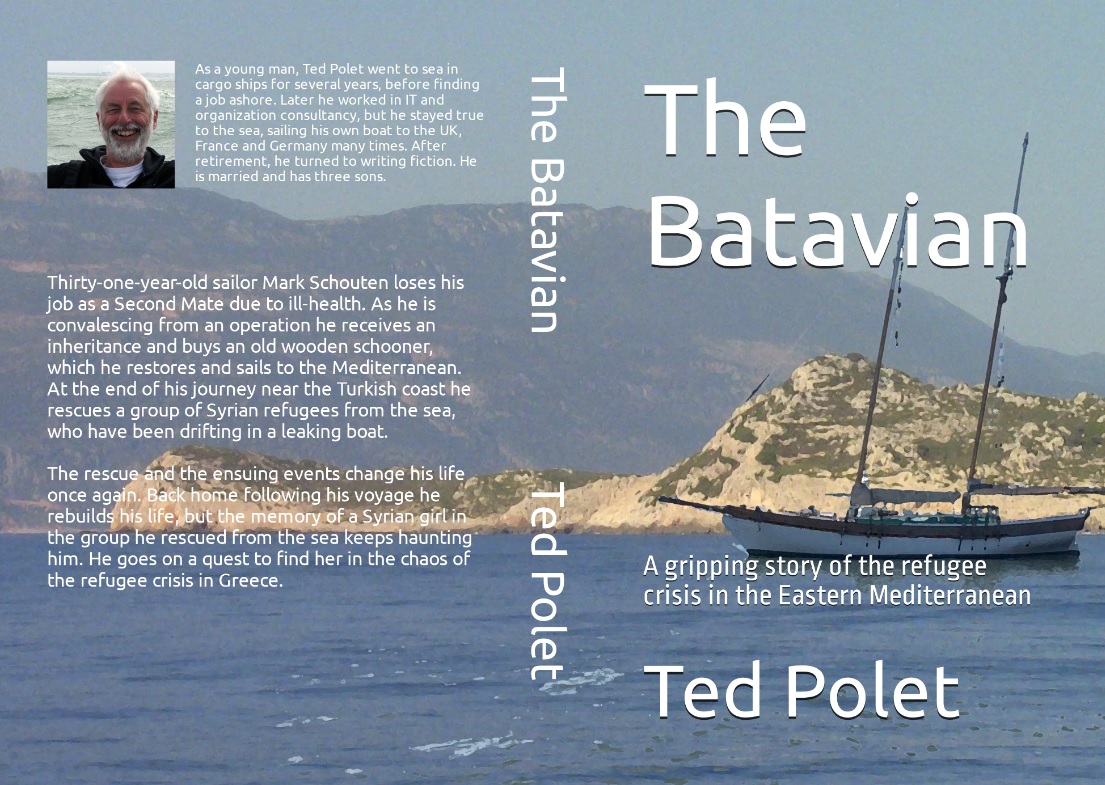
Thirty-one-year-old sailor Mark Schouten loses his job as a Second Mate due to ill-health. As he is convalescing from an operation he receives an inheritance and buys an old wooden schooner, which he restores and sails to the Mediterranean. At the end of his journey near the Turkish coast he rescues a group of Syrian refugees from the sea, who have been drifting in a leaking boat.

The rescue and the ensuing events change his life once again. Back home following his voyage he rebuilds his life, but the memory of a Syrian girl in the group he rescued from the sea keeps haunting him. He goes on a quest to find her in the chaos of the refugee crisis in Greece.

click for extract from manuscript

Videotrailer for The Batavian:


Wednesday, 19 July 2023

Pushbacks at sea and in the desert

Recently I wrote of the denial of identity during slavery, and the parallels with the way Europe deals with migrants today. New developments have prompted me to write a separate article on this subject. The first item is the much-discussed Tunisia deal of the European Union in relation to pushbacks, which apparently also take place in the desert.


The newest attempt to reduce the stream of migrants from Africa is the Tunisia deal, in which the Dutch Prime Minister Rutte and his ultra-right wing Italian colleague Meloni, under guidance of EU president Ursula von der Leyen negotiated a commitment from the Tunisian dicator Saied, who will receive a sum of money and carte blanche to serve as a border guard for the EU. We know where that leads to from the example of Libya, where migrants are jailed in dire conditions, physically abused or even enslaved, or quietly disappear from the face of the earth. The earlier deal with Turkey, another country with an autocratic regime, only resulted in longer and more dangerous migration routes over the Mediterranean.

To my surprise and disgust, Rutte, whose Cabinet was toppled last week over another migration issue, together with Meloni and Von der Leyen has pushed through the migration deal with Saied. Here we see the proud trio holding hands with the Tunisian dicator. Holding hands with someone who has blood on his hands. Human rights organisations are astonished - see replies below.

source: NOS


Amnesty International: Our Government has to take human rights seriously. There shouldn’t be a deal with any country if we know in advance that we will finance human rights violations.

Vluchtelingenwerk Nederland (a major refugee support organisation): Europe turns Tunisia into a dead-end alley for refugees and migrants.

Stichting Vluchteling (another refugee support organisation, on Twitter): ‘With all consideration for human rights’, Rutte recently said about a deal with this man who jails his opposition, calls for violence against migrants and makes life difficult for refugee support organisations, leaving people without water in the desert. Human rights. Well, well.’


Deportation of migrants from the Tunisian harbour of Sfax. These people are said to have been abandoned in the desert. Source: NOS


The bloodstained hands of Saied are no invention of mine. Tunisia has a bad track record on the subject of human rights and racial discrimination. Following the popular coup and democratic movement a few years ago, the country is once again in the steel grip of a ruthless dictator, who relentlessly pushes through a racist agenda in his country, stirring up feeling against black migrants from the south.

What this leads to is clear enough – recently a few journalists from Al-Jazeera found hundreds of people who had been dropped in no man’s land on the Libyan border without food, water or shelter, by the Tunisian authorities.

And only yesterday more people were found who had been dropped in the desert by the Tunisian army, who even stole and destroyed their passports and thus proof of their identity.

migrants abandoned in the desert by Tunisian troops. Source: NOS


But our recently dismissed Prime Minister Rutte, who is only supposed to handle current affairs and not pursue controversial issues, claims there are enough safeguards for human rights. Naturally he would.

EDIT August 2, 2023: finally, Dutch Parliament seems to wake up - questions have been asked of the Cabinet about recent deaths in the desert on the Tunisian/Libyan border. And the Belgian Undersecretary for Asylum is calling upon the European Commission to monitor human rights in North Africa more closely.  

EDIT September 12, 2023: The EU Parliament made mincemeat of the Tunisia deal. ‘It is a dirty deal with a dirty dictator,’ says one European Parliament member. ‘The racist policy of Saied actually is the reason people flee the country, and this deal will never lead to less migration.’ Another MEP says this is ‘treason to European values.’ Regrettably the European Parliament was bypassed when the deal was concluded - one effect of the remarkable political structure of the Union, which is less democratic than it should be.

Pushbacks at sea

Tunisia’s neighbour Libya has its own bad track record due to countless pushbacks and other human rights violations. The most recent incident was a Red Cross-sponsored rescue action being fired upon by the Libyan coast guard, on July 11. There are clear indications that the EU-financed Libyan Coast Guard works in collusion with human traffickers and is even infiltrated by criminal gangs. This is literally admitted by the European Commissioner for Migration. Even so, this situation is kept out of the media and no one seems to care a jot. Probably the EU finds the criminal Libyan approach to migration an effective deterrent.

taking cover from Libyan shots fired at a rescue mission. Source: International Red Cross / NOS.


The Greek pushback disaster of last month

Now let us look at Greece, where international law has been violated for years already. Once again, the terrible consequences of pushbacks of migrants in the Mediterranean were in the news. Hundreds of people drowned miserably in a dilapidated old boat that apparently was going to be towed off to Italian waters by the Greek Coast Guard. For me as a former Merchant Navy officer the risks are crystal clear: the vessel was overloaded and unstable, and trying to pull incautiously at such a vessel using a hawser will capsize it. Look at the way the vessel was overloaded: 

the overloaded disaster vessel capsized at sea near Greece


Pushbacks are illegal actions by European authorities to send migrants back to the place they came from, or to sea, without verifying the legitimacy of their claim to asylum. Illegal, because this is contrary to international regulations as laid down in refugee treaties and international maritime law, and they often lead to loss of life. The authorities concerned always point the finger at human traffickers as the cause of the problem, denying their own role. In the case of the capsized boat with 700 people on board, the Greek Coast Guard is now under investigation, as is the part played by Frontex. Which naturally is being vehemently denied.

New information points at an unsavoury role of the Greeks. They reportedly put pressure on the survivors to keep their mouth shut. A Dutch news article refers to BBC interviews with some of the survivors:

Two survivors the BBC spoke with confirm that the Coast Guard tried to tow the Adriana (i.e. the disabled vessel) off. “They fastened a rope to the left hand side. Everyone then moved towards the other side to keep the vessel horizontal. The Greek vessel then moved off fast, capsizing our boat”, says one of the survivors. The BBC says this was confirmed in court testimonials of five more witnesses.

Once ashore, the survivors were told not to speak about what they had seen. “When some said that the disaster had been caused by the Coast Guard, the translator had to say to them that they had to keep their mouth shut,” said the other witness the BBC spoke with. “You have survived! Keep your mouth shut! No more questions!” reportedly had been shouted at them.

Europol will ‘assist’ the Greek authorities to get at the truth of the matter. We will have to see what comes of that.

Short-term thinking only delays the solution

Does this mean we will have to accept the endless stream of refugees and migrants, despite all the social consequences? And should we shut our eyes to the activities of the traffickers? Of course not, because most of the people who flee from their birthplace become deeply unhappy here, and the housing and administrative problems increase time after time. But all these politically (i.e. anti-immigrant) motivated deals with repressive regimes only have a short-term effect. What is needed is statesmanship aimed at a long-term solution to make the world a better place. Statemanship regrettably is hard to find today.

I will repeat what I wrote in my previous post.

What is needed is vision, not a lump sum given to an unpleasant regimes to serve as a gatekeeper for Europe. Instead of subsidising a dictatorship, there should be proper investment in the countries of origin of migrants, to create worthwile jobs for everyone in Africa, with the returns flowing back into that unhappy continent. Only that will stop the flow of migration, the trafficking and the deaths at sea and in the desert.

Tuesday, 18 July 2023

The importance of identity

Broken chains

On July 1st we celebrated the end of slavery in Suriname and the former Dutch Caribbean colonies, effectively 150 years ago. The remembrance day is called Keti Koti, Surinamese for Broken Chains.

King Willem Alexander of the Netherlands formally apologised for slavery and for the role his royal forebears played in the slave trade. On June 30, prior to the celebration, I attended a ceremony in the monumental St Bavo church in Haarlem, where recently the grave of a Surinamese woman was re-discovered. Susanna Dumion was taken from Suriname to Holland as an enslaved woman by her owner in 1753. She lived to a great age and passed away in 1818, 105 years old! Her life was investigated 200 years later, which finally gave back an unknown woman her Afro-Surinamese identity.

Mariska de Jong, Chairwoman of the Haarlem branch of the Slavery Remembrance Committee in this country, is writing a book on Susanna Dumion’s life. 

A wreath is laid on Susanna's grave


Identity is a key word in slavery, as one of the effects of slavery was the denial of identity in people who strongly leaned on the oral tradition of their forebears. The connection with their African past was brutally cut off, which not only harmed the people themselves, but also the communities they came from.

Disrupted societies

Recently, Dutch historian and author Martin Bossenbroek was interviewed on TV following publication of his new book De Zanzibar Driehoek (The Zanzibar Triangle, not yet available in English), about the slave trade on the African east coast. At some stage he mentioned the disruption of traditional African communities due to many centuries of slave trade. It set me wondering: could this disruption be linked to the present-day migration tide into Europe?


I wrote several novels, of which The Batavian is set against the background of migration in the Mediterranean. My latest book Anansi is an historical novel with the slave trade as its background theme. So naturally I wondered about a possible connection between the slave trade and present-day migration, and started an investigation of my own.

Dehumanisation is of all ages

Enslaved people and the indigenous population of colonial areas weren’t seen as people with their own feelings and dreams. They were commonly described as stupid, without morals or character, denying them their identity and culture. This ineradicable attitude took root in the minds of plantation owners and slave traders and eventually became a common opinion in western minds. Even though the tide is turning, we still see the consequences today: open or hidden discrimination.

arrival of a slave ship

The parallel with present-day treatment of migrants cannot be denied. Rejecting their own culture and values, the humiliating treatment before we allow them into our country. The pushbacks to sea of the virtual wrecks in which they arrive on our coasts, refuting all international treaties.

the deadly routes to Europe (source: NOS)

The way migrants are being dehumanised cannot be shown more clearly than in an article which I found in the Dutch press. When another of these unseaworthy boats full of migrants founders at sea, the victims are buried in anonymous graves, without bothering to find out who they were. Their families are left in uncertainty about their fate. I’m afraid the article is in Dutch, but here it is:

https://nos.nl/artikel/2480215-onduidelijkheid-over-lot-migranten-op-weg-naar-eu-verschrikkelijk-voor-families

The article concludes as follows: It is an obligation we have as human beings to one another, but especially in Europe as a community. Even if we do not want them here, then let us at least show them respect by giving them a name and a face.

Africa is shackled to the past

Let us focus on Africa for a moment, even though migration isn’t only an African thing. According to Marie-Laurence Flahaux and Hein De Haas (2016), poverty in itself isn’t the only cause of migration, as is often assumed. If you are too poor, you cannot even travel. But poverty lies at the base of migration all the same. As soon as the mean income of a region increases by a tiny margin, people are seen to take to the road to find a better life elsewhere. They are condescendingly called ‘fortune seekers’ over here, as if that is a bad thing. I am a fortune seeker myself, and you, dear reader, probably as well.

https://comparativemigrationstudies.springeropen.com/articles/10.1186/s40878-015-0015-6

Poverty and violence are the cause of a great deal of migration even inside Africa, and Africa itself knows closed borders not unlike the European outer boundary. It is a universal control reflex of authorities.

Looking at a study by Nathan Nunn (2007) of the lack of economic development in Africa, it appears that 20 years ago (it is an old study) the mean yearly income in Africa was about 40% of the income in other developing countries. In some countries it is slowly improving now, but that apparently only fuels migration.

Jamestown, Accra, 2012


What surprised me, and now we are looking at the link to the slave trade, is that according to Nunn the lack of economic prosperity in Africa is greatest in regions where the slave trade was strongest!

Are we finally being presented with the bill?

So perhaps I’m jumping to conclusions, but we might say that Europe is now being presented with the bill of the slave trade from the past, as the Africans from regions destitute through the former slave trade, who are now marginally able to pay a human trafficker, are now knocking on our door.

https://scholar.harvard.edu/nunn/files/hup_africa_slave_trade10.pdf (Nathan Nunn)
 

Apart from the economic angle, there is another effect. In some areas of Africa, mutual distrust between people, and mistrust of authorities is rife. Authorities are seen as the enemy, which doesn’t really surprise me. And it has an effect on behaviour of people during migration, where they are confronted with authorities bent on making life difficult for you. It may even have an effect on the death rate during migration.

The interesting thing is that Nunn has found that distrust also is a legacy of the slave trade: there is more distrust amongst people in areas ravaged most by the slave trade. 

https://dash.harvard.edu/bitstream/handle/1/11986331/nunn-slave-trade.pdf (Nathan Nunn)

Finally 

I know a Ghanaian family who have managed to put one of their sons through University. That young man now has a certificate of his ICT training, but finding a job in Africa depends on having influential friends. He is working hard to find a job, but meets with little success. Such young people are greatly at risk to end up as a migrant on the shores of Europe.

Do I have a fitting solution? I haven’t studied international relations or whatever qualification is needed to find a solution. But my common sense says this must be solved at the source. Closed borders, pushbacks and dirty deals with dictatorial governments will not hold back the tide of migrants. So don’t bribe dictators to act as gatekeepers for Europe, but invest in working opportunities and equal prospects for everyone in Africa. Eventually that will put the brakes on migration, human trafficking and deaths at sea.

On July 1st, 2023, we looked back in horror on the days of slavery. But did we learn the lessons from the past? Will there not be a need for more excuses by governments, 150 years from now, when our descendants look back with horror on the way Europe now deals with migrants?