Tuesday, 24 January 2023

An author and the publicity machine

It is several months since I posted anything new on my blog, mainly due to having had a busy period preparing publication of my fourth novel ANANSI, which will appear in Dutch by the middle of June, to be followed shortly afterwards by an English translation published on Amazon/Kindle.

Most authors prefer thinking, daydreaming, researching and writing. And refining, time and again, every part of the manuscript which he or she has been working on for a year or more. The next stage is the most challenging: publishing and promoting your work.

The first thing to do is find a publisher, unless you already have one. Contracting a literary agency with the proper connections helps a great deal. Publishers roughly fall into two categories. The first one performs paid publishing services, which means the copyright remains yours and you have to pay for every step in the process. The other is one who you sell your copyright to. They take the risk and generally charge you a modest start-up fee. Understandably, royalties will be far less in this case, because a publisher needs to make a profit and cover his risks.

start screen of the slide show

Relaxing with a cup of coffee before starting

In the last stages of production and printing, the next hurdle is publicity: press releases and lectures. In lecturing and presenting there is a great deal of fruitless work, because one can never predict the amount of, or lack of success. I have occasionally prepared a lecture where, despite ample advertising, no one turned up! On the other hand, I often addressed an audience of dozens of people. It isn't for nothing that my publisher urges his authors to keep faith in their book, even if there is an occasional setback. Some book presentations are arranged by your literary agent, but it pays to do your own scouting and to mobilise your social contacts.


What else do I do in the way of publicity? I write this blog, I have a website (https://tedpolet.com), and I create video trailers like the one above, and thus increase my internet footprint. 

Social media supposedly work as well, but not for me. I tried Facebook, but despite the fact I only posted my profile and a photo of my boat, I had repeated trouble with one of their stupid algorithms blocking my account for unknown reasons. Goodbye Facebook. Now, my literary agent Hanneke van de Water takes care of Facebook for me.

Reviews and critics

By now I have seen many reviews of my books (in the Dutch language domain, that is). Most of these were very positive – I even received four stars out of five in the Thriller and Detective Guide of a Dutch national newspaper for my latest book Two Fathoms Deep (the English version is available from Amazon, as a paperback and as an e-book). My other books The Cargo and The Batavian also received commendable reviews, which of course is very welcome to an author.

However, naturally one or two reviewers don’t take kindly to your book or your style of writing. Well, you can’t please everyone, can you? The problem is that an unfavourable review is potentially damaging to your book. You work like a slave for a year or more to create it – believe me, it is very hard work! – and then someone writes something that makes your toes curl... Criticism can be functional however, and you have to cope with it and try to learn from it. Naturally not everything in your book can be top notch, and there isn’t always a happy match between an author and a reader or a reviewer. But the most important thing is to keep faith in your book, despite what some people write of it.

Those confounded American bestsellers

Generally, a Dutch language author does well if he sells a few hundred copies. This means he is in eternal competition with translated English language novels, many of them written by American bestseller authors who easily sell a hundred thousand copies. They are translated into Dutch and sell a few thousand more copies over here, supported by a powerful marketing strategy. Those translations crowd Dutch booksellers’ shelves and the literary pages in mainstream newspapers. In consequence you’ll always be at a disadvantage, similar to ‘niche’ English language authors, who struggle as well. In the Netherlands, with probably a thousand or more excellent authors, there may only be a few dozen who can actually can live off their writing.


Writing therefore is an expensive hobby to most authors. Is that a bad thing? Not necessarily, unless you dream of generating an income from your books. I don’t break even with any of my books, but the nice thing about authorship is that sometimes a reader approaches you, saying he or she couldn’t put your book away. I often maintain that a book’s quality can be measured by the lack of sleep of your readers. 

Regrettably there are one or two disappointing books even by famous bestseller writers, who clearly haven’t done their homework. Bad homework is what I try to avoid at all cost, which means I spend a great deal of time researching the background of my books. I will write some more about research in due course.

Lectures and press releases

Last week I was a guest at a community centre in my home town of Leiden, where I gave my first lecture after a long time. I spoke of writing and researching, and also made an early announcement of my new book ANANSI. It proved to be one of my most satisfying book lectures ever, for an audience of about fifteen people, most of them over sixty years old. They asked excellent questions, some even disputing my views, resulting in deep-ranging discussions. Such questions give me energy and new ideas.

having fun, talking to my audience

Meanwhile my agent Hanneke van de Water, who did the initial editing rounds of the ANANSI manuscript and also takes care of press contacts for me, wrote a press release. This is what she wrote, roughly translated:

Following the appearance of his debut novel ‘The Batavian’, Ted Polet gave several lectures on his book and on seafaring in general. Everywhere he went he managed to capture his audience. His lectures radiated fun and an unmistakable passion. At the publication of his second novel ‘The Cargo’, the Covid pandemic threw a spanner in the wheels, but now he is back again. With a new book and new lectures!

Last week he spoke in a community centre in Leiden, and once again he addressed a very interested audience, nor was he shy of interaction. More lectures will follow.

Ted’s most recent book was last year’s ‘Two Fathoms Deep’, which once again turned out to be a thrilling novel, in which past and present are matched in a fascinating way. And... there is even a new book on the way now, in which he turns another corner. Where his previous books all were present-day thrillers with a seafaring theme, Ted now goes all historical.

His new book will appear in June, entitled ‘ANANSI’. It is an historical novel against the background of the slave trade and Suriname’s sugar plantations at the end of the 17th Century. Ted Polet proves to be the master of more than one kind of theme, which is proven without doubt by ‘ANANSI’ – so watch the appearance of this beautiful novel!

Note that the English version of ANANSI is now being prepared - I recently completed the basic translation of the manuscript and at present I am doing the first of several reviews, re-reading the manuscript and weeding out all the grammatical and content glitches. Naturally, it will take a considerable time before I am satisfied enough to ask a few friends to review and correct it as I have done with previous books. Watch this space!

Sunday, 6 November 2022

Not before time

They finally managed to utter the A-word: the State of the Netherlands will soon apologise for the slavery enacted in this country’s history. Wild horses couldn’t drag them to admitting the role of the Dutch in the slave trade and slavery in the Caribbean plantation economy. Perhaps a sigh of relief could be uttered, but the Cabinet should have made a more generous and timely statement about a sensitive matter that has been on the agenda for a decade or more.

Why should they apologise? Can anyone today be held responsible for what has been enacted in the past? The answer is simple and twofold. Firstly, the responsibility for slavery constitutes a political debt of honour that has never been acknowledged. Secondly, the slavery of the past still casts its shadow upon present-day society, in Surinam and elsewhere in the Caribbean region, but also in the Netherlands.

slavery monument, Amsterdam
 

The State of the Netherlands is the heir of the Staten-General of the Dutch Republic, which during the 17th and 18th Century gave a ‘patent’ to investment companies such as the Dutch West India Company (WIC), the Society of Suriname (SVS) and the Middelburg Commercial Company (MCC). This patent allowed them to trade and exploit enslaved people.

In the course of their existence of around 170 years, these companies bought over half a million African people from local chieftains in Africa and in horrible conditions transported them to Curaçao and Surinam, where they were sold and for about 8 years (on average) were literally worked to death. The colonies weren’t subject to Dutch law, which forbade slavery, but to Company regulations, which did not have the slaves’ wellbeing in mind.

Restored plantation house, Mariënbosch

After the Kingdom of the Netherlands was created in 1815, this despicable machinery persisted for nigh on 60 years under pressure from the planters and investment bankers, in spite of the international abolition movement having risen in the early 1800s. In 1863, slavery was abolished, but only in name, because the powerful planters’ lobby demanded a clause in the abolition law that forced the freed slaves to continue working for their masters for another 10 years, supervised by - you may have guessed - the State of the Netherlands. The same which now, 150 years later, had to be dragged reluctantly towards a formal apology.

These people weren’t really free until 1873, and even then they were at an impossible disadvantage. The effects are visible even today: their descendants have a more than average chance of poverty and social disadvantage, not speaking of dormant or open racism.

Mariënbosch plantation 19th Century, slave quarters at right

Even after 1873 there wasn’t an end to human trafficking and exploitation, because shortly afterwards the first shiploads of indentured labourers and their families arrived, having been lured from British India and the Dutch East Indies with hollow promises, then being put to work on the plantations under almost unbearable conditions. If their circumstances provoked protest and violence, the colonial authorities clamped down without mercy, as they had done with previous slave rebellions.

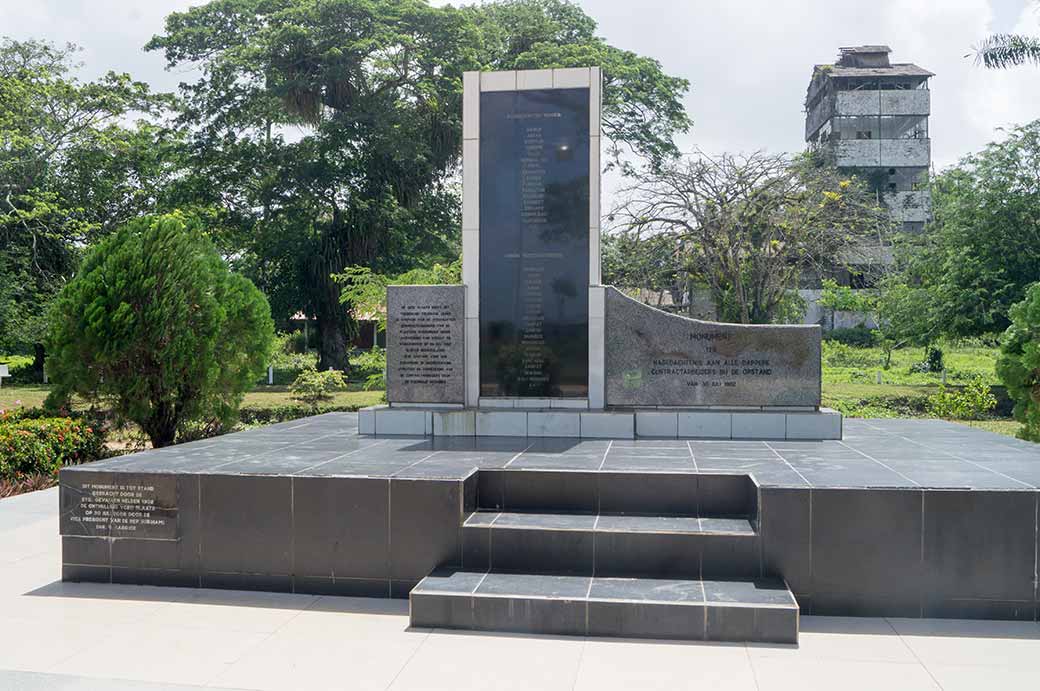
A notorious example is the rising amongst Hindustan contract labourers at Mariënburg on the Commewijne river in 1902. They had murdered the tyrannical director of the local sugar plant after a conflict over halved wages and indecent treatment of their womenfolk. Not very nice, I agree, but the Colonial authorities sent in the army, which shot and killed 16 people and grievously injured about a dozen more, who perished later. The dead were savagely defaced and exhibited in public ‘pour encourager les autres’, then buried in quicklime. The grave was never discovered. In 2006 a monument was erected to them. I recently visited it and stood dumbly watching it with the hot tropical sun burning my head.

Monument for 1902 insurrection, Mariënbur

source: https://www.ozoutback.com.au/Suriname/commewijne/slides/20160121019.html 

Anyone wishing to learn more about slavery in Surinam should read the 1934 book written by that eminent author Anton de Kom: We Slaves of Surinam. If even one of the slavery deniers on the extreme right in Dutch politics would read it and managed to have the guts to acknowledge what has been perpetrated, it might make a difference.

Perhaps someone will remember that as late as 2020 our Prime Minister Mark Rutte spoke of making apologies for our slavery history in terms of ‘a complicated issue.’ In other words, he didn’t want to burn his fingers at it and antagonise his political supporters in the VVD party (translates as the People’s Party for Freedom and Democracy). How stubborn the opposition is, became obvious at the furious response from that party, one MP describing the proposed ‘awareness fund’ of EUR200m as complete madness. Not mentioning the unprintable replies of a few more extreme right wing groups. 

Anton de Kom, author and Resistance fighter, 1898-1945

What is the usual response in this country to a controversial issue? They instate a committee to research the problem and vacillate as long as politically opportune. Yes, I can imagine an ‘awareness fund’ of 200 million not being the most useful compensation. It might be better to address the present-day damage due to past slavery. But I don’t hear a thing about that.

At the moment media and politicians in the Netherlands are yelling with indignation at the exploitation of contract labourers building football stadiums in Qatar. But who are we calling names? For centuries we did the same in the Caribbean, although that is long enough in the past to cover up.

And now I’m at it, how about present-day exploitation of thousands of Eastern European labourers and the hovels they are housed in by their Dutch employers? Or how about the way our authorities handle asylum seekers, who are kept in tents and filthy housing not fit for human habitation? Attempts to improve on these outrages are constantly blocked by that same coalition party (VVD) which carries the word FREEDOM in its name. Freedom for some. 

Nothing. Has. Changed.

Saturday, 24 September 2022

About Anansi, the Kiskadee and other Surinamese experiences


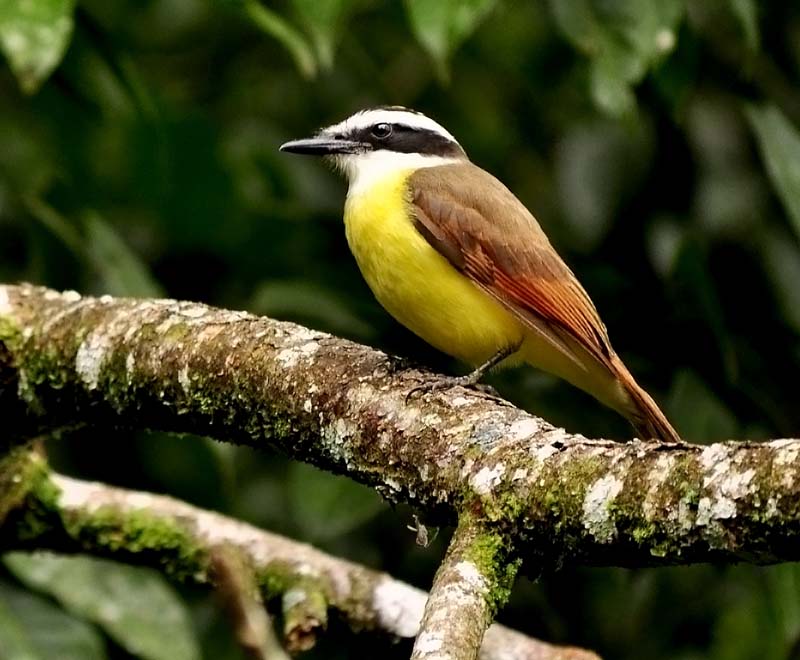
Great Kiskadee (source)

I recently made a trip to Suriname with my wife Henriette. A wonderful experience and a must for anyone who loves untouched natural beauty and new cultures. For me there was a second reason: the desire to do on-site research into a country that plays a part in the book that I will publish next year.

Elmina Castle, Ghana

The title of the book will be ANANSI, I've been working on it for over a year and the Dutch manuscript is now with my editor (I will translate it into English later). It is an historical novel, set at the end of the 17th century in Elmina, the headquarters of the Dutch West India Company on the former Gold Coast (now Ghana) and in Suriname, on the South American north coast next to the Guyanas. The main protagonists are a young African woman, a house slave of a Spanish slave trader, and a Dutch sailor, who are irresistibly attracted to each other. The forbidden relationship comes to light and the girl is sold and put on a slave ship to Suriname. He manages to get aboard another ship to search for her on the opposite side of the Atlantic.

the Suriname river at Gunsi, Sipaliwini district

A central theme in the book is the folk stories of Anansi, which in West Africa are handed down from mother to daughter and travelled across the Atlantic with the slave trade. Anansi is a smart spider, who plays all kinds of tricks. The girl from Africa tells the stories she learned from her grandmother and takes them to Suriname.

To my surprise and delight, during my trip I was invited for an interview about my writing by the national Surinamese newspaper De Ware Tijd, an account being written by local journalist Audry Wajwakana (in Dutch).

sunrise over the Suriname river, Gunsi

I saw the horror of the slave dungeons of Elmina 10 years ago, but I had never been to Suriname. I'm not going to mince words about slavery, because the cruelties which Dutch human traffickers, slave skippers and planters perpetrated for 200 years are undeniable. This despicable and inhuman machinery still leaves its mark and is only being recognized in the Netherlands with difficulty.

rain clouds illuminated by the setting sun at Gunsi

We need not be eternally ashamed of what was perpetrated by previous generations as that wasn’t of our own doing, but it must be admitted honestly and without holding back. It must be written down in history and generous compensation should be offered to the descendants of the victims. But the State of the Netherlands has been unable to utter the word 'apology' for years.

Even though the truth is duly known, all kinds of delaying tactics seem to persist under the pretext of 'due diligence', the real reason being unwillingness to face the facts. The charade was continued during our PM Mark Rutte's recent visit to Suriname. He stuck his his head into the sand once more and said something vague about action being taken next year. Next year? Take responsibility Mark, admit it honestly, reach out to Suriname so we can put the past behind us and look to the future. It can be done today, or would that offend your voters?

Restored plantation house at Mariënbosch, Commewijne

Apart from the burden of the past, our journey was a unique experience. We saw so many beautiful things and met so many nice people. Who in the Netherlands knows about the Great Kiskadee, which is called ‘Grietjebie’ in Suriname, a yellow-breasted bird the size of a starling that loudly calls its own name? And who knows the Kankantrie, the spirit tree that is revered in the jungle because it houses the Busigado, a forest spirit? Who knows that when entering a Maroon village, men must walk on the left and women on the right? And who has raced through the rapids of a fast-flowing jungle river in a pirogue fitted with a large outboard engine?

dead trees in the coastal swamp at Bigi Pan, Nickerie district
 
islet in the Maratakka river, Nickerie district

I invite you to travel to Suriname for a few weeks, get to know the beautiful country and its friendly inhabitants and then return home with a warm feeling.

sunset over Bigi Pan


Monday, 29 August 2022

Our collective shame

Writing is fun, but not always. I’m not sure how much of this has gravitated to the international press. Two years ago I wrote about Camp Moria on the Greek isle of Lesbos, which features in my book The Batavian:

Two years on, we have our own version of Moria inside Dutch borders: the intake centre at Ter Apel in the far north, now has all the symptoms of a concentration camp: filth, neglect and utter desperation of hundreds of people. A symptom of a failed Government that for years has cut down the asylum system to the absolute minimum, and now apparently is unfit for dealing with a normal influx of refugees. The lack of housing for those who received their refugee status, the complete collapse of the Immigration Service, local authorities refusing to offer asylum seekers proper refuge, magistrates ordering tents removed that were put up intended as minimal shelter, locals protesting against a refugee centre in their own back yard, everything has contributed to our own Camp Moria, where Médecins Sans Frontières and the Red Cross had to come in and offer basic aid because the State of the Netherlands turned its back on their duty to offer refuge and comply with international treaties which they themselves signed. We are now officially a third world country.

The dismal policy of previous center-right wing Cabinets led by Mark Rutte has made a mockery of the Immigration Service, who suddenly cannot cope with refugees. A queue of heartless Conservative Party (VVD) undersecretaries have unrelentingly removed resources from the Service. Mark Harbers, Ankie Broekers-Knol, Eric van der Burg, all of them exponents of the same hard-hearted right-wing anti-immigrant ideology. Sickness and death reign in Ter Apel - a 3-month-old baby died in the Centre last week, and several people were sent to hospital by MSF. People suffer from scurvy, there are no toilets or showers, nothing. The Cabinet ignored the shameful situation for weeks, until MSF stepped in and refugee support organisations threatened to file a lawsuit against the Government.

Not until Health and Youth Inspectors visited the site on 26 August, the urge was felt by the Rutte administration to evacuate people to temporary shelter. As if those responsible hadn’t an idea of the situation. Finally this weekend, people have been taken away in buses to a safer place.

According to several refugee treaties, we are obliged to shelter people. And don’t think the stream of human wreckage will dry up because Mr Rutte has now instated what he calls a ‘decent reduction of refugee influx’ to cope with the crisis. His measure consist of ... maybe you have read it ... a moratorium on family reunion, flouting every treaty there is on this subject. A shameful policy preventing parents to see their children, or children to see their parents for up to a year and a half. How much damage this despicable idea will cause no one can predict, but we’ll probably see when, in a few years time, a parliamentary investigation will turn up the result - even more people irreversibly damaged. We ignore what happens, because they say there is no alternative. ‘He who cannot is buried in the churchyard, he who will not lies outside,’ my grandmother used to say.

Refugees are used as a weapon by dictatorial regimes - Lukashenko, Putin, the Taliban, Assad, the ayatollahs - to de-stabilise the West, as Lukashenko did at the Polish border last winter. Sending back those who came from a ‘safe country’ is being frustrated by the countries of origin, who don’t want to play along. But that doesn’t diminish our obligation to treat every refugee who knocks at our door with respect and care.

Shall I tell you about asylum seekers? In my town of Leiden (a city of refugees, as the Council likes to boast) we had a large number of refugees FOUR times in about fifteen years, including the recent influx of Ukrainians, who by the way receive preferential treatment and don’t have to submit to the infernal conditions of sleeping outside in all weathers in Ter Apel.


We never had any problem with these people - they are almost invisible. In 2016 a few hundred Syrians were given shelter here. And what happened? A Syrian man giving football training to about a dozen Syrian kids in the park, who had great fun. But when recently there was talk of housing a number of refugees in an empty building not far from where I live, the local newspaper published letters from a few well-to-do people in the filthy rich neighbourhood next to it, who feared all those scary foreigners would start walking through their road to the nearby supermarket. Such is the xenophobic atmosphere in this country, fanned by a number of irresponsible politicians.


I feel ashamed for what my country has come to.


Saturday, 20 August 2022

Two Fathoms Deep - paperback

Shortly before we departed for a 5-week sailing trip to the United Kingdom, I completed publication of my latest book Two Fathoms Deep as a paperback. I ordered one copy from Amazon and took it with me aboard to re-read it and check for any remaining errors. I often do so when a book is published - if the printed version manages to capture my imagination, it should be all right...

I only found one or two typos, which for the moment should be acceptable.

yours truly checking the set of the mainsail

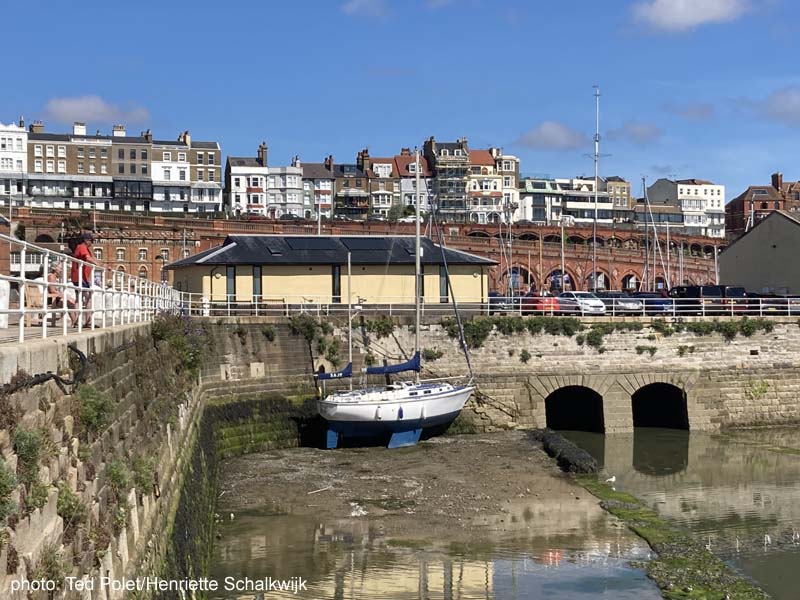
Meanwhile, we sailed south towards the Belgian coast and continued west, step by step, crossing the Channel near the Sandettié light vessel and ending up in Ramsgate.

The Sandettié light vessel, anchored in the centre of the shipping lanes


We had a very good time afloat and it was good to be back in the UK, the first time after the Covid crisis hit us. The most northerly place we went to was Pin Mill on the Orwell, still a magical place full of old wrecks.

Pin Mill

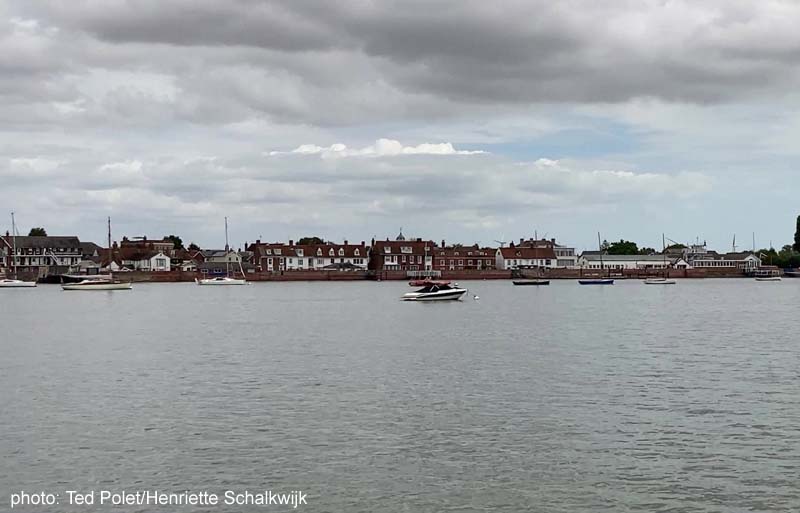
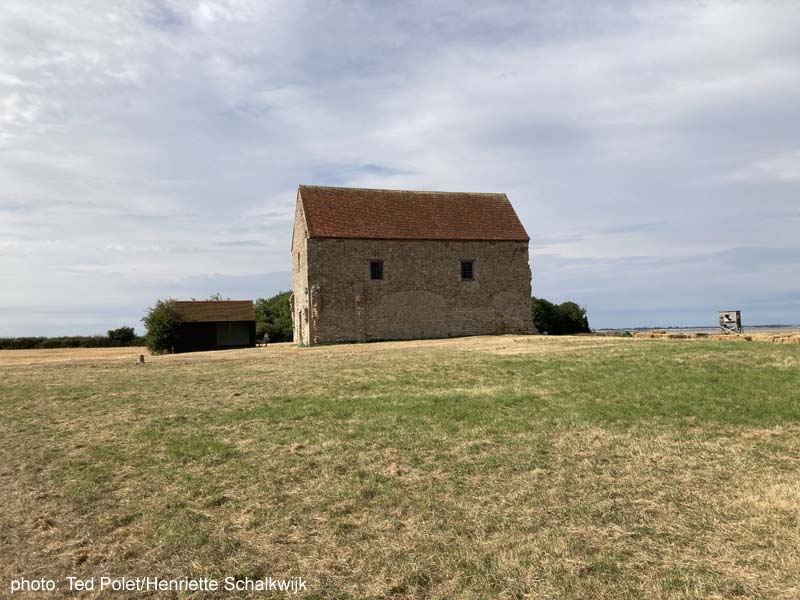
On the way back, we re-visited several places that play a part in Two Fathoms Deep - Stangate Creek, a side creek of the Medway, where a stolen cargo was landed, Burnham-on-Crouch, where a shooting took place, and the chapel of St Peter on the Wall on the coast near Bradwell, where another crime was committed. We came there 11 years ago and they gave me part of the inspiration for the book.

Stangate Creek (Medway)

Burnham-on-Crouch

St Peter on the Wall, Bradwell

In Chatham we met an old friend of mine, Chris O'Donoghue, who is an author himself. He writes the Sonny Russell series of thrillers. I gave Chris the copy of Two Fathoms Deep, which he is now reading himself. He even took it down to the beach recently, making this photo - it is as if the photo is an extension of the cover, which I suppose Chris intended!

Two Fathoms Deep on the beach - Chris O'Donoghue photo

My other books will be published as paperbacks in due course - but first there is another foreign trip awaiting me - part holiday, and part a study trip for my next book.

Saturday, 4 June 2022

Good news about my books

Last week was a busy time for me as an author.  First of all, I heard that Drie Meter Zand (Two Fathoms Deep) received an excellent review in the Vrij Nederland Detective and Thriller guide, published by a national newspaper. The book actually received four out of five stars, an improvement over Het Transport, which got three. Regrettably the review is in Dutch, so you'll have to translate it. Google is your friend (sometimes...).


The reviewer rightly concludes that I have little praise for the Dutch police, but perhaps that should be broadened, because for many, government and officialdom aren't an ally anymore, but have become an enemy. Popular distrust has grown over the years due to a multitude of scandals. Probably it has become more visible as a result of social media, magnifying every embarrassment to impossible proportions. There is little you can do right in present-day government. It is high time to restore trust, but up to now I do not see much improvement.

Anyway, Drie Meter Zand came out well and I hope my readership feels emboldened to purchase and read the book (note that the English translation is about to be published - see below!). For those who want a foretaste, check out my website www.tedpolet.com or watch the video trailer: 


I have now presented the book for the first time at the 52-year anniversary of a sailing club of which I have been a member for about 40 years. I have sailed a certain type of lightweight plywood boat for years, even at sea and as far as England. They held a race in which my current boat was appointed start/finish boat, which saw yours truly armed with a large air horn!

my old 23 foot marine ply boat

my current boat serving as a finish ship

yours truly (in sunglasses) watching the finish line

the race in progress

the presentation - I'm holding a copy of The Cargo

The presentation was a great success, all the more because I have a good advocate in the club who reads and reviews my books for their newsletter. For years our boats were side by side as we worked on them in winter storage, and I still help him with some odd jobs.

My next book presentation is scheduled for June 25 in the harbour shop of the marina in Andijk, where our boat is berthed.

Finally, as I mentioned above, there is news about the English translation (TWO FATHOMS DEEP), which is about to be published as a paperback on Amazon, where the digital version has been available for some time. I received the proof print today, and apart from a few minor details, it looks good. Some small improvements and I can finally publish it! I will report as soon as that is the case.

the proof print (marked Not For Resale) to the left of the Dutch original


Tuesday, 29 March 2022

Peace in our time

A month ago, the Russian destruction machine started up in Ukraine. Putin hopes to go down in history as Tsar Vladimir the Great, but I think he will be remembered as Volodya the Terrible. Outside Russia, that is, because the words "invasion" or "war" are banned in Putin's new Greater Russian Empire, where a repression has begun that has not been seen since the years under Stalin or Brezhnev. Last month I wrote 'poor Ukraine', but it could just as well have been 'poor Russia': the people feel the pain of the repression and the sanctions, not the dictator in the Kremlin.

Aleppo

There is another parallel with the 1930s. The West did
frantic business with Putin in his role as an oil salesman and turned a blind eye to Grozny, Aleppo and Georgia. Pleasing this despicable man for his cheap oil and natural gas reminds me of the period when Europe turned a blind eye to the horrors of Nazism and did its best to appease Adolf Hitler. Neville Chamberlain, who stood elated in the doorway of his plane in 1938, waving a signed treaty authorizing the German invasion of the Sudetenland. Peace in our time: we know where that led to.

Peace in our time

The refugee flow from Ukraine is comparable to the Syrian diaspora created by Putin's friend Assad.  A Syrian refugee I spoke to years ago told me that at the time, in Aleppo the Russians were in charge.  Aleppo, which
was razed to the ground by Russian air raids. If you will not listen and surrender to my aggression, we will destroy you.  Women, children, hospitals, schools, residential areas. Mariupol is Aleppo version 2.0. Remember Putin's remark about a fly in your mouth which you spit out. That is how he sees the women and children of Ukraine. 

Edit 3 April: details have just come to light of the horrors of Bucha. Civilians arbitrarily shot in the streets by Russian soldiers - when will this senseless killing stop? What happens here is similar to the Nazi atrocities of Oradour-sur-Glane, Putten, Khatyn or Babi Yar. Who will bring these butchers to justice? 
 
Nekulturny.
 
Mariupol


Refugees, the EU and the Netherlands

A remarkable difference between refugees from the Middle East and Ukrainian refugees is that men, women and children from Syria and Afghanistan are not welcome within the EU.  Preferably they are held in detention camps in Greece or stopped by Polish border guards at the Belarus border, where they had to camp out for months in the winter cold. Ukrainians may enter unmolested, even without documents. Why not the Syrians? Our constitution says that all people in similar circumstances are equal - apparently only if they come from Europe. In the Netherlands, Syrians and Afghans have to go through a lengthy and humiliating asylum process, as a result of which many will be disadvantaged for the rest of their lives.

Camp Moria, Greece

It seems that equality of refugees in the Netherlands is mainly
found in the degrading conditions in reception camps such as Ter Apel, where the Council is now threatening to close the place, because it is overcrowded, and at the same time they - believe it or not - won’t allow extra barracks on the site. There is now talk of dusting off an emergency law forcing municipalities to take in people and requisitioning any vacant real estate (good for you, real estate speculators!) so that refugees are offered decent housing.  But it always takes an agonizing amount of time in this country.Government always hides behind due diligence on politically difficult issues - the same diligence that is unimportant when it suits the political leadership. 

A new book coming soon

Due to the terrible state the world is in, I almost forgot mentioning that my new book Drie Meter Zand (Two Fathoms Deep) will be published soon. I lately invested a great deal of work in this together with the publisher. I will write more about that soon, but not in this same post. It might spoil your and my appetite.