Wednesday, 17 April 2024

The best preserved part of Africa in South America


Exhibition of the Maroons in Suriname

On April 6, 2024, an exhibition was opened in the Kennemerland Museum in Beverwijk, Netherlands, about the culture of the Maroons in Suriname. It was an initiative by Mariska de Jong and Iwan Jhintoe, two Maroon descendants living in the Netherlands, and I put a lot of work into it together with Mariska and the museum, thanks to Cees Hazenberg and Teatske de Jong. 

part of the exhibition


Following the opening, I gave a lecture about the Maroons. See abstract below.

About the Maroons and slavery

Surinamese slavery was a system of human exploitation on an industrial scale: in Suriname alone it affected 220,000 people over a period of 200 years. The slave owners were a numerical minority and did not view those people as persons, but merely as a means of production. The victims were often worked to death. The planters used oppression and dehumanization as their tools -  humiliation and denial of identity. This still affects their descendants today. 

The 18th Century Mariƫnbosch plantation house


There would have been no Maroons without slavery. As a result of the harsh living and working conditions, many fled the plantations into the forest. They and their descendants are called Maroons. 

The connection with Kennemerland

The Kennemerland region behind the dunes to the west of Amsterdam was closely connected with Surinamese slavery, and therefore also with the "maroonage", the flight from the plantations that resulted from slavery.

There was someone named Gerrit Pater, a Beverwijk-born young man who left for Suriname in 1705 and died in 1744 as the richest man in the colony, owning three plantations. Half of Suriname was in his debt.

And many rich country estates around the Wijkermeer - the headwaters of an inlet of the Zuyderzee - were owned by Amsterdam merchants, heartless investors of the 17th and 18th centuries, who had interests in plantations. 

The Akerendam mansion at Beverwijk was the property of Amsterdam plantation owners


The first Maroons

The first Maroons probably already fled the plantations in British times. After the conquest of Suriname by the Dutch in 1667, the British planters gradually departed. 15 years later, most plantations were Dutch property. The number of plantations then grew rapidly, increasing the number of enslaved workers and the flight from the plantations.

Resistance and peace

By 1750, about 3000 Maroons lived deep in the wilderness of Suriname. Many were engaged in a bitter guerrilla with the planters and the government, who were steadily losing the struggle. In 1758, Paramaribo finally throws in the towel and offers peace to one Maroon tribe: the Okanisi. Then in 1760 the first treaty follows with Okanisi, followed by treaties with the Saamaka and the Matawai. Other groups however never make peace, such as the Aluku of Captain Boni.
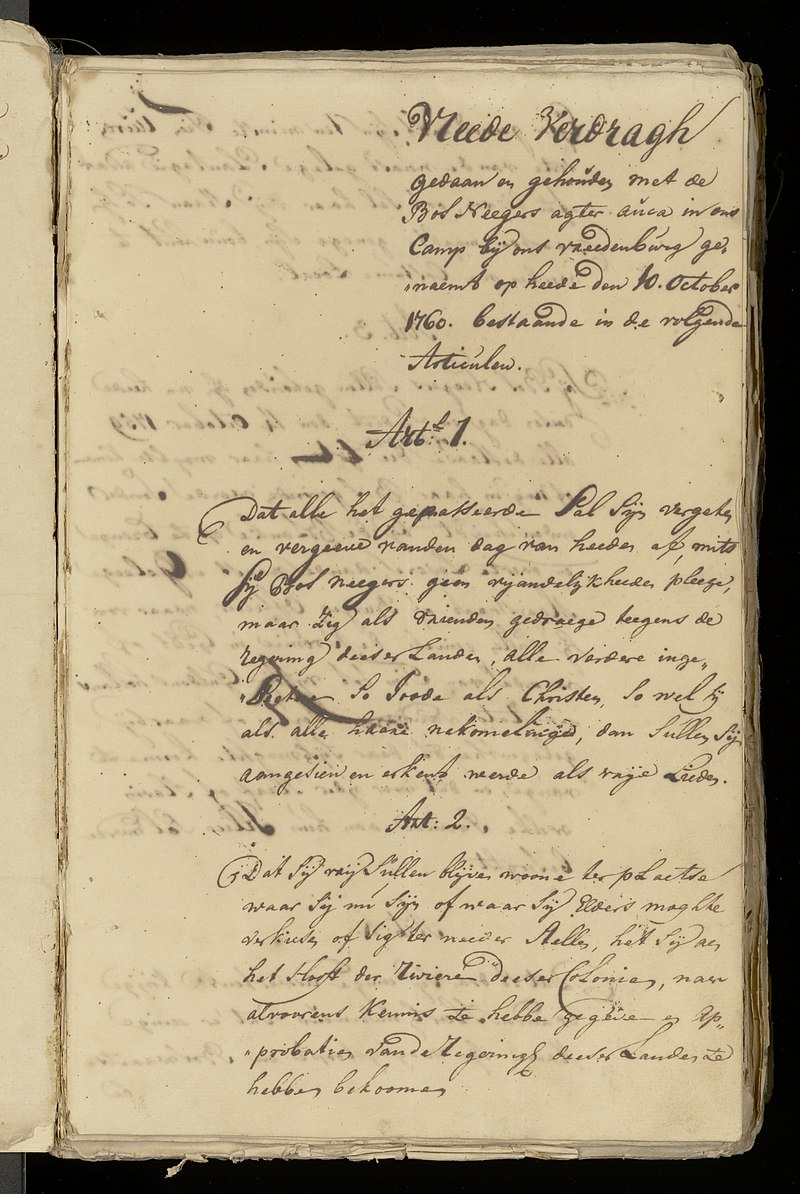
The 1760 peace treaty between the Colonial authorities and the Okanisi tribe. source: National Archives, through Wikipedia.


The Surinamese Maroons of today

Present-day Maroons are directly descended from the Maroons of the past. The peace treaties allowed a hard but secluded and peaceful life in the forest, and as a result, they preserved many of their original African traditions.

Maroon village of Gunsi, upper Suriname river.


African roots

In Africa, traditionally there is an animist belief and a strong bond with the ancestors. This is clearly present in today’s Maroons. Many of them feel a strong connection with nature, everything around them containing its own power or spirit. They practice the water ritual, which honours their ancestors, and many other rituals, for example around life and death. They have also preserved the oral storytelling tradition of Africa such as the stories about Anansi, the spider.

The bond with nature

An example of the bond with nature is the Kankantri, the African kapok tree, which also grows in South America. The Kankantri is worshipped in the forest because it houses a busigado, a forest spirit. Sometimes a meal is placed under the tree for the busigado, and unaccountably, the food has always disappeared the next morning! 

Kankantri, the ghost tree


Rituals and ancestors

Rituals are highly important in the Maroon culture. They strengthen the ties within the community and with the ancestors, at birth, marriage, illness and death, but also on other formal occasions, such as the opening of the exhibition in Beverwijk. Here the water ritual was carried out, which has the deeper meaning of the journey of the ancestors over the ocean and also has a cleansing function. In addition, a libation was offered to Mother Earth. I was present at the ritual, and it made a great impression.

Anansi - photo and overlay by Ted Polet


African storytelling

Where there is no written language, knowledge and wisdom are transferred orally from generation to generation with stories, often about Anansi, the spider, which were handed down from West Africa. Those stories aren’t just for fun - they also have a deeper meaning. In Africa, Anansi, the son of Mother Earth, is the messenger of the gods to mankind. He steals wisdom, but accidentally drops it to the ground. And then this happens ...

The river took the wisdom that Anansi had gathered to the sea, which it spread all over the world.

And that is why a little bit of wisdom lives in us all.

Mother Earth

In Ghana, Mother Earth, the mother of Anansi, is called Asaase. In Suriname she is called Mama Aisa or Gronmama (literally: Earth Mother). She is the goddess of the dry, exhausted earth and of death and welcomes the deceased in the spirit world. You even have to ask her permission to bury someone’s body.

Asaase Yaa/Mama Aisa (source unknown)


But she is also the goddess of fertile earth and new life - look at the infant in her arms in the image above. And so once more, we touch the beliefs of the Maroons: a life cycle that starts before birth and continues after death.

Secret messages

The Maroon culture is full of secret messages, which are well understood by the recipient. They are in embroidery patterns, wood carvings and the painted pattern on utensils. The 'pari' or paddle is used to steer the pirogue, but it also directs life, which is shown in the carving at the top and the painted pattern on the blade.


Pari, or paddle for a pirogue. Photo by Mariska de Jong


The secret messages are also in the language of the Apinti drum and of the "telephone tree" .

Apinti

Apinti is a way of speaking with a drum. Its origin lies in West Africa, and the sound can be heard for miles in the jungle. Once it was used to signal the presence of an enemy in the forest. Speaking with the drum is a difficult art. The drummers must be inaugurated and must have a thorough knowledge of the rules. Apinti also has a ritual meaning. The drummer not only speaks to people, but also with the supernatural. 

Apinti 'doon' - the drum played in the forest. Photo by Mariska de Jong.


The telephone tree has deep recesses in its trunk, and gives a hollow booming sound when you knock on it it with a stick. The language of the telephone tree is the same as that of the drum.

My friend Olan Dinge knocking on the trunk of the telephone tree, Gunsi, upper Suriname river.

 
The flyer designed for the exhibition

Sunday, 24 December 2023

Maryam

Christmas is the feast of the weak.

Today, Christmas Eve, 2023, I held my first grandchild in my arms once again. She is six weeks old and perfect, and it was sheer wonder to see how little she needed to still her hunger and to carry her around till she slept.


I just saw an interview on TV of the Moroccan author Abdelkader Benali. He told the story of Maryam, to whom an entire book of the Quran is dedicated. Maryam, who retires into the desert when she is unaccountably pregnant, because she isn’t a girl of ill repute. No, said God, you aren’t a girl of ill repute, but you will bear a prophet. She is given water when she is thirsty, and when she is hungry, there is a fig tree that lowers its branches so she can pick the fruits to eat. Traditionally, the fruits of the fig tree are important for safe childbirth. 


Maryam, an old Persian miniature (Wikipedia)


The Quran story is different from ours, but not very much. No different from Mary and the ox, and the ass, and the child in a crib. That also is a story of poor people, of refugees, of weak ones who can only find refuge in a stable, between the beasts breathing softly and giving warmth so the child won’t go cold.


It may well be that this child was a Palestinian child, over 2000 years ago.


I won’t say that all Palestinians are without guilt. But when I think of the Palestinian children in Gaza, who have been bombarded for months in revenge for an horrible act of terror, I feel cold. Starry-eyed children, innocent little ones, of whom by now over eight thousand were slaughtered by a revenge exercise that even the vengeful God of the Old Testament couldn’t have thought of.


Christmas 2023. Drawing by Emad Hajjaj.


And then there are the three Wise Men from the east. The wise men who were led by a star that appeared in the sky. Wise men who may have come from Afghanistan, or Iran, or possibly from the North African desert, to pay tribute. Those people are nowadays locked up in what amounts to concentration camps, as they aren’t welcome anymore in Europe, as laid down in the new Migration Pact. The Christmas story is acted out again day after day, even now. But we haven’t learned a thing.


The churches in Bethlehem are empty in 2023, because no one goes there anymore. “How can we illuminate a Christmas tree whilst Palestinians in Gaza are killed in their thousands?” Ashraf Tannous says, a Palestinian preacher in the Lutheran church of Beit Jala, near Bethlehem. 


The child Jesus in a pile of rubble. Source: NOS.


In the Lutheran church of Bethlehem, the child Jesus normally lies in a crib in the stable, surrounded by Joseph and Mary and the three Wise Men from the east. The child is now pictured in a pile of rubble, wrapped in a keffiyeh, the Palestinian shawl which emphasises its Palestinian identity. It reminds us of the thousands of Palestinian children in Gaza, killed by the bombardments.


Christmas is the feast of the weak. Let us spare them a thought when we sit at the Christmas dinner.


Tuesday, 19 December 2023

About wisdom

Wisdom is the greatest asset of mankind, even more so in today’s world, where it seems wisdom is as rare as hen’s teeth.

The day before yesterday I spoke of wisdom, storytelling and reading during a meeting about Surinamese poetry and prose, which I had been invited to by my good friend Mariska de Jong, a Surinamese lady from Haarlem. Part of the meeting was a traditional water ritual, which has a great symbolic meaning to the Surinamese, as their ancestors were carried across the water from their birthplace.

Mariska de Jong and some other participants. Source: De Pletterij, Haarlem


It was great fun, especially when one of the Surinamese participants, after my lecture, asked me mischievously whether I might be another African. My reply was ‘yes, a white one,’ upon which we burst out laughing together. 

Here is a livestream of the event, unfortunately only in Surinamese and Dutch without subtitles, made by De Pletterij, a cultural and debating centre in Haarlem. My contribution starts at 21 minutes 20 seconds.


To make up for the lack of English, I'll give you an extract of the lecture I gave, and a conclusion.

THE ART OF STORYTELLING

How did our ancestors share their wisdom? All over the world, stories were told after dark, when people sat together with an oil lamp, a candle or a fire. In Europe we used to have folk tales, many of which were eventually re-told and collected by the Grimm brothers into a book of fairy tales.

Here, we only know these stories as fairy tales, but in the African culture, the art of storytelling is still very much alive. In West Africa, as I wrote before, many of these stories are about spiders, about Anansi, once the messenger of the gods, now an earthly scoundrel and a cheat who sometimes is cheated himself. The Anansi stories travelled with the slave trade to the Americas and the Caribbean, where they are even told today, centuries later.

In my recently published historical novel with the same title Anansi, a young girl called Efua tells the stories of Anansi to the children of her village. The first chapter looks like something out of a children’s book as she tells the story of Anansi who tries to steal all wisdom. This tale (I think) comes from a collection written down by the British africanist R.S.Rattray, about a century ago, but I backdated it to the 17th Century.

yours truly reading a chapter from his book. source: livestream by De Pletterij


Efua’s story ends in a metaphore: the river took the wisdom collected by Anansi to the sea, which spread it all over the world. And thus, a little wisdom lives in us all.

Soon, the innocent children’s book takes an horrible turn as Efua is taken from her village by slavers and subjected to all kinds of cruelty. Efua will never learn to read or write, not even as a grown woman, but she had preserved her ancestors’ wisdom in her memory, and would eventually take it to Suriname. She is, in my book, the embodiment of all those thousands of women and men, who took the knowledge of their ancestors with them across the ocean.

An English translation of the story Efua tells of Anansi and wisdom can be found HERE.

READING AND WRITING

Our early ancestors, whether we have African, Asian, American or European roots, usually couldn’t read or write. That was reserved for very few: even kings and chiefs often couldn’t read or write - they had wise men and priests to write for them. But lowly traders and farmers, even though they couldn’t write, often jotted down what was sold or harvested by scoring the amount on a stick, or a stone.

Over the centuries, book printing as well as education made reading and writing into an important factor shaping our society. And inevitably during the late colonial era, reading and writing were introduced in Africa, the Caribbean and other colonial regions.

Even so, the lack of reading skills today is a source of concern - it seems that one-third of the 15-year-olds lacks basic reading and writing skill needed to function in society. We have social media, breaking news, over-stimulation by almost everything thrown
into your private life by television and the smartphone. Wisdom, or what passes for it, today is transmitted by television talkshows or by Facebook or Tiktok, so why should you want to read in the first place?

I feel that reading is a source of information, or possibly wisdom, which you can compare at leisure with other sources or even with the knowledge you already have. But reading also is a pleasant form of relaxation, even though you may have to learn appreciate it and take time for it. And the most enjoyable form of reading is reading to your children. I have recently become a grandfather and even now I am anticipating the joy of reading to my granddaughter when she will be one or two years old.

I learned to read thanks to my parents, who had cases upon cases of books and from a young age urged me to read. I still have many books from their collection, most of which are falling apart with age. Some of them I still re-read every few years. They feel like a worn old armchair that you don’t want to get rid of because it is so familiar. The advantage of reading is that you take the contents at your own pace without being hurried by images, sound and pace of a television. Reading awakens your imagination, makes you think, teaches you about other opinions and adds to your own wisdom, or perhaps to realisation how little you really know…

Thus, a book is a little like the river that took Anansi’s wisdom to the sea, which spread it all around the world.


I won’t claim that all I write is wisdom, on the contrary, most of it comes from a rich imagination that sometimes gets the better of me. But what is my goal? I mainly want to tell a gripping story that captivates my readers, much like the ancient storytellers of Anansi, or Reinaert the Fox, or Brer Rabbit. But I also like to do my homework because the background of my story has to be right. Perhaps that is the wisdom I try to convey in my tales.

A book is a form of entertainment: it has to capture your imagination and must be difficult to put away. When you have read a chapter, the urge must remain to turn over another page and then another. Emotion also plays its part in my work: there are parts I cannot re-read without feeling the emotion again that went into writing them. The protagonists in my books have become my friends, or perhaps my children. No wonder, as I created them myself.

The personages Evert and Efua in my book Anansi are the product of my emotion. I try to describe their feelings, how they come together and how they learn to cope with the adversity in their lives, but also the friendships with others who support them in their most difficult moments and help them along in life.

Isn’t emotion, next to wisdom, the most important quality of mankind?

Mariska de Jong and Cherida de Ziel


WISDOM IN TODAY’S WORLD

On the Dutch edition of this blog I recently wrote of my confusion and my doubts of today’s world, and the extreme cruelty of the wars in Ukraine and Gaza, which the world was plunged into once again by a malevolent dictator, by horrible terrorism and a trigger-happy populist, as if we haven’t learned a thing.

We haven’t learned from the Holocaust, not from the Nakba, not from colonial cruelties and our history of slavery, or Vietnam, Chile, Bosnia, Iran, Georgia, Aleppo, Afghanistan, Irak or Sudan. It is apparent in the hostility preached by slick politicians towards contrary opinions, towards foreigners, refugees and ‘fortune seekers’. Politicians that exploit the chaos created by a failing governance of their own making. It is always the other man’s fault, never our own. We are going through a dark age and I fear for the world that we leave to our children.

A people gets the leaders it deserves, said Joseph de Maistre in 1811 (Toute nation a le gouvernement qu'elle mƩrite). As James Freeman Clarke, an American thinker, wrote several decades later (I can only mention him once again): The difference between a politician and a statesman is that a politician thinks about the next election while the statesman thinks about the next generation.

Only statemanship can save us, but sometimes it seems the river that carried Anansi’s wisdom to the sea has dried out.

I wish you and us all a great deal of wisdom in the year 2024.


Sunday, 5 November 2023

Recent promotion work


Despite the horrors and war crimes committed in other parts of the world, it is hardly conceivable that normal life also goes on in most places. We hardly realise how lucky we are.

On Saturday, October 28th, I gave a short presentation of my book ANANSI at a local bookseller, a few minutes from home. It was a much shortened version of presentations I gave previously, tailored to the location, consisting of no more than the video trailer (see below) and a short talk of 10-15 minutes, enough for a public that of necessity has to stand.

the setting


The people in the shop had put a neat table at my disposition, with some flowers and a stack of my books - ANANSI and my previous titles.

I had brought a TV to use as a large monitor and sound system for a computer with the video, the Powerpoint and a slide show. And a Kente cloth and an Ashanti mask from Ghana, to create some atmosphere.


The presentation was well patronised, mainly by friends, neighbours and family members who hadn’t attended my previous talks. I even met an unknown namesake, who probably has the same ancestors I have, about 200 years ago.

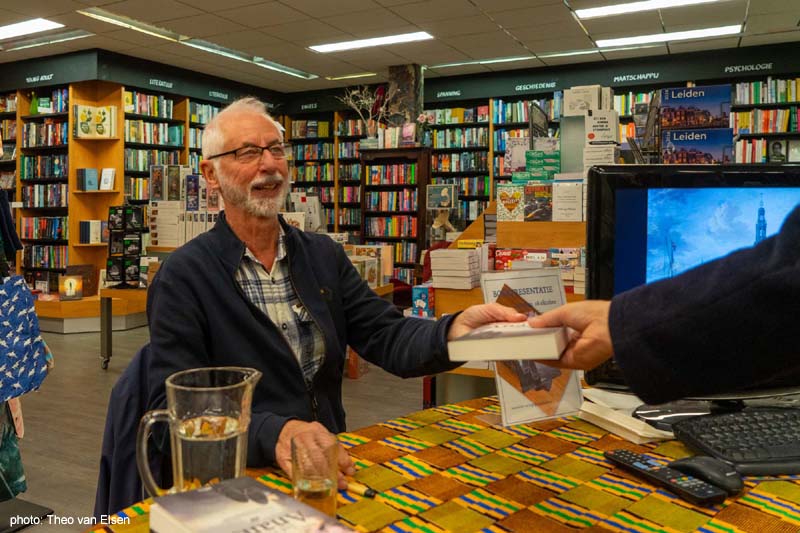
signing my books


The shop sold 14 copies of my books, all of which I autographed, not a bad result for such a small event. They were well pleased with it, as I was myself. They planned to keep a few copies in stock for a week or so, and kept my ANANSI banner in the shop over the weekend.


 Biblioteca Barlaeanorum

I haven’t yet written of a recent visit to my old secondary school, the Barlaeus ‘Gymnasium’ in Amsterdam, where I did my ‘A’ levels over 50 years ago, in 1970. I fondly remember that school for the excellent teaching I received, in modern languages, Latin, classic Greek, mathematics and science.

Barlaeus Gymnasium, Amsterdam


The school maintains a collection of books written by alumni, which is grandly named the Biblioteca Barlaeanorum. They already had a copy of my first book The Batavian, so now I brought them a copy of each of the others: The Cargo, Two Fathoms Deep and Anansi, naturally all in Dutch, which brought their collection up to date.

Biblioteca Barlaeanorum


The future

Giving lectures is great fun: for instance, sharing all the knowledge I gathered of the transatlantic slave trade. This is an enjoyable bonus of authorship - I have a great deal of material to turn into a tailor-made lecture. Such as the historic perspective of the slave trade, and how it was organised, and seafaring in days long gone. Or the early history of the Colony of Suriname, and the mutiny and murder of its first Governor in 1688, or the role of the well-known Anansi stories as cultural heritage of the Maroons, the descendants of fugitives from the plantations. And how to turn a simple idea into a complete novel...

I’d love to give a lecture overseas, but that is hardly practical. So I’m afraid all I can do to promote my work in the UK and elsewhere in the English language domain is write about it on my website or this blog. Or perhaps use the publicity machine of Amazon...


Monday, 16 October 2023

An eye for an eye

History repeats itself

Writing isn’t always fun, as the title of this blog implies. Up to now I didn’t want to write of the new Gaza war, because there are no words to describe the mutual cruelties being inflicted. But perhaps it is good to try and learn from history - an essential task for an author. Many years ago, I experienced some Middle Eastern history at close quarters.

Yom Kippur 1973

Exactly 50 years ago, I arrived in the Middle East in a Dutch cargo vessel, shortly after the Yom Kippur war, in which Israel was surprised by an invasion on two fronts from Syria and Egypt, and barely managed to save its skin.

My ship, the mv Oostkerk, prior to departure from Rotterdam in June 1973


The (then) Dutch Defense Minister Henk Vredeling secretly supplied arms to Israel, even without telling his boss, Prime Minister Joop den Uyl. When Vredeling blabbed on TV, naturally the Arabs were furious and imposed an oil boycott against Holland. And my ship was boycotted when we arrived in Latakia, Syria. We barely escaped unharmed. 

Three quarters of our cargo, which came from India and Sri Lanka, was destined for Lebanon, Syria and Libya. Having discharged some cargo in Barcelona, Marseilles and Genoa (where I celebrated my 22nd birthday), we continued to Beirut, still uncertain about the situation awaiting us. Halfway between Crete and Cyprus we passed a US Navy force which included an aircraft carrier.

Our Third Mate plotted large forbidden areas in the chart of the Levant, war zones full of minefields - there were only ‘safe’ corridors to Beirut and Latakia. At the time they were still fighting on the Golan heights.

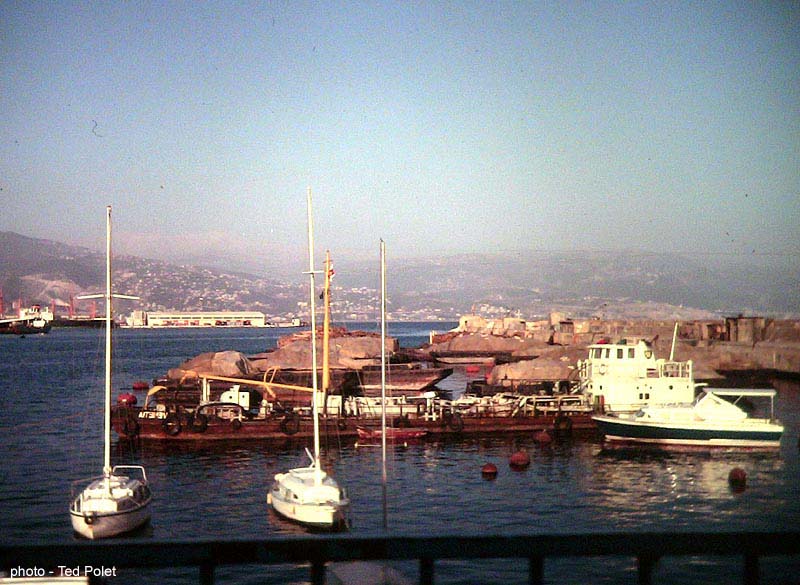
Beirut, November 1973. It still looks peaceful, but tension in the city could be felt and civil war was about to break out.


We cranked the lifeboats outboard, ready for launching in their old-fashioned davits, and closed our only watertight door, that between the engine room and the propeller shaft tunnel. It was clear that we were headed for a war zone. How it ended can be read in my website:

https://www.tedpolet.com/epages/zv08.htm

It could be a theme for a new book - perhaps it will appear at some stage...

An eye for an eye

50 years hence, following intifadas, continous rocket attacks, terrorism and cruel border wars, now we have seen a gruesome attack by Hamas in the south of Israel, followed by an equally gruesome retaliation war started by the Israelis, who are effectively carpet bombing a densely populated area to get at Hamas terrorists sheltering under the city. The scale of cruelty is mind-boggling, with thousands of dead on either side.

Who wants to understand the source of this conflict, should go back to the flight of hundreds of thousands of Palestinians from their lands in 1947-1949. Many were driven out by violence and terror by the newly formed State of Israel. An horrible example is the Deir Yassin massacre in 1947, perpetrated by Israeli murder squads, one of which (the Irgun) was commanded by Menachem Begin, later Prime Minister of Israel. Others left at the invitation of neighbouring Arab countries, who at the time may have thought to benefit from it. The Palestinians still refer to this as the Nakba, the disaster. Nowadays we’d call this ethnic cleansing, a word some people won’t thank me for. If you object, then please point out the difference to me. What’s in a name.

Following WW1, Syria, Lebanon and Palestine were designated a mandate area to be administered by the French and the British. In those days, urged by the Zionist movement and supported by the British (the Balfour Declaration), migration began of the Jewish diaspora to the Promised Land. And inevitably, soon the first tensions developed between the Jewish colonists and the Palestinian locals, who naturally viewed the colonists as invaders. When the British eventually put the brakes on immigration, Zionist militants turned on them.

Should we refuse the Jews a safe country, after having been ravaged by pogroms and the holocaust? Should we refuse the Palestinians a safe country of their own? Whoever has the answer, please tell me. The two sides are entrenched against one another, each held hostage by ideology and bitter hatred fed by a century of violence.

the results of a 1948 car bomb set off by Arab militants in Ben Yehuda Street, Jerusalem.


The two-state solution, once advocated to return to the Palestine people at least part of their ancestral lands, probably is the only possible compromise. But how to get two uncompromising parties back at the negotiating table? 

The theft of land, the de-humanisation and aggression by Jewish colonists in the Israel-occupied territories has continued for decades, feeding the monster of terrorism at the other side. 

Meanwhile, foreign powers such as Iran, Russia, Qatar, Saudi Arabia and the United States are stoking the fire relentlessly, each with their own agenda.

The Norwegian cartoonist Morten Morland drew this appropriate image of Netanyahu hitting Gaza, as ayatollah Khamenei blows out the match he used to light the fire. Note the tiny image of a woman and child fleeing, silhouetted on the hillside.


I will not take sides, even though Western politicians fall over each other to express their support for Israel, ignoring the devastating retaliation war that is being waged by the Israelis against the terrorism of Hamas and similar groups. An eye for an eye - the spiral of revenge will never come to an end. It isn’t just Israeli children, but also Palestinian children who have a right to live. 

All that remains for me is to express deep regret and sympathy with all the thousands of innocents to both sides, who once again fell victim to this almost insolvable conflict.

Additions and corrections November 4th: 
 
The conflict is even more complicated than I realised at first, as the political situation in the Middle East is marked by wide-spread distrust within the Muslim world.
 
Hamas is connected with the Sunni Muslim Brotherhood. The Hamas leadership hides itself in Qatar, which has for years vied for power with Saudi Arabia. A probable cause for the 7 October attacks by Hamas on Israel is the overtures made by the Saudis to Israel, which apparently have now ceased. 
 
In Qatar talks are going on between Hamas and the Iranian Foreign Ministry - apparently a pact is being forged against a common enemy.

blood on their hands: talks in Qatar between the Iranian Foreign Minister and the Hamas leader Ismail Haniyeh, October 14 (source: CBC News.)


Hezbollah, which is based in Lebanon, is a Shiite group supported by Iran and Syria. Even though they are fighting Israel, they haven't deployed their full power, possibly under American threat. 
 
Meanwhile, the death toll in Gaza passed the 20,000 mark, 8000 of whom are innocent children, as opposed to 1139 Israeli victims (corrected numbers 1/1/24). All proportion is gone from the Israeli retaliation. When will there be an end to the violence caused by the war-mongering leadership to both sides? The Netherlands refused to demand a cease-fire and refrained from voting in the UN. What a disgrace. Meanwhile, the world looks on in horror. 


Monday, 2 October 2023

A summary of my books


Up to now I haven’t done a great deal of promoting the English editions of my books, so to make a start, I decided to give you an overview. My books were originally written and published in Dutch. 
 
ANANSI, TWO FATHOMS DEEP, THE CARGO and THE BATAVIAN are now available from Amazon, in paperback and Kindle e-book format. They were also released for general availability through booksellers and can be ordered using the ISBN and the title. I will now give a short description of each book, including a link to an extract and a video trailer.


ANANSI

ISBN: 9798395461148


ANANSI (2023) is an historical novel set against the slave trade and the Surinamese plantations at the end of the 17th Century. It is the story of the forbidden love of an enslaved woman and a Dutch sailor, who against all odds and the harsh reality of the slave trade hold on to one another, hoping for a better life in freedom. The tale begins in fort Elmina, the headquarters of the Dutch West India Company in what used to be the Gold Coast (Ghana today). It then moves across the Atlantic, ending up in the colony of Suriname shortly after the Dutch take-over in the late 17th Century.

The main protagonists are Efua, a young African woman enslaved by a Spanish slave trader based in Elmina, and a rebellious Dutch sailor, who feel irresistibly attracted to one another. The forbidden liaison comes to light and the girl is sold and put aboard a slave ship to Suriname. The young man manages to talk himself on board another ship to go and search for her on the other side of the Atlantic, a search full of hardship in the South American jungle.

ANANSI is a gripping tale of the Dutch slave trade and the horrors of the Surinamese plantations, about Caribbean pirates, hurricanes and the deprivations of seafaring in times long gone. The folk tales of the spider and smart trickster Anansi, which in West Africa are related by the elders to the younger generation, travelled to Suriname with the slave trade, and are at the core of the book. Efua tells the stories she learned from her grandmother and takes them with her on the slave ship to Suriname.

click for an extract from the book

Videotrailer for ANANSI:


TWO FATHOMS DEEP

ISBN: 9798509954160


What happened to the cargo of the French brig-of-war 'Arabelle', which lay hidden under the sand for two hundred years?

TWO FATHOMS DEEP (2022) is the story of the wreck of the French brig-of-war 'Arabelle' of Napoleon's day, which lay two fathoms below the sand off the isle of Ameland for two centuries. A young man and his girlfriend, who is a descendant of a survivor of the disaster, find enigmatic documents in the legacy of her deceased grandmother.

The personal logbook of a soldier from Napoleon's army gives them a clue to the position of the wreck. Shortly after its discovery the valuable cargo in the wreck is pillaged by ruthless salvage hunters who leave a trail of violence behind. The plot moves from the Dutch coast to the Medway and the Essex rivers.

TWO FATHOMS DEEP is an historical novel that culminates in a contemporary thriller. The wreck and family ties are wrought into a surprising link over the centuries.

click for extract from manuscript

Videotrailer for Two Fathoms Deep:


THE CARGO

ISBN: 9798859000036


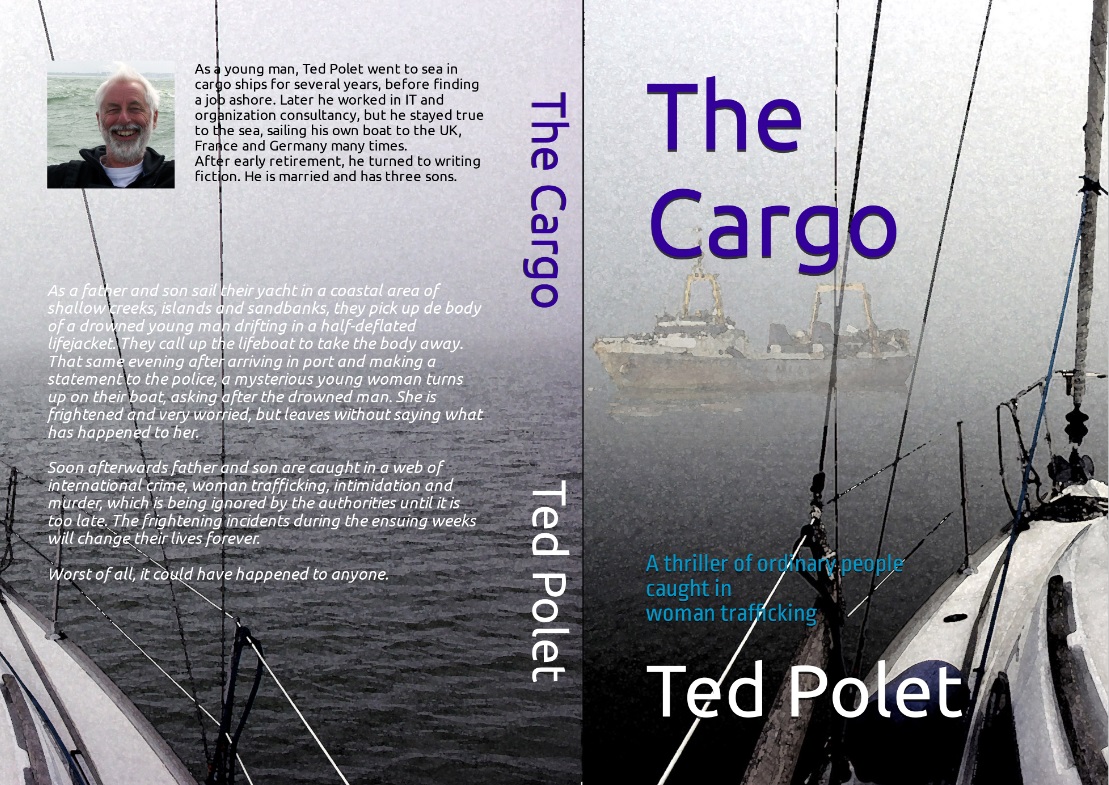
THE CARGO (2020, revised 2023) is a thriller of ordinary people caught in woman trafficking.

As a father and son sail their yacht in a coastal area of shallow creeks, islands and sandbanks, they pick up de body of a drowned young man drifting in a half-deflated lifejacket. That same evening after arriving in port and making a statement to the police, a mysterious young woman visits their boat, asking after the drowned man.

Soon afterwards they are caught in a web of international crime, intimidation and murder, which is being ignored by the authorities until it is too late and more bodies turn up. The frightening incidents during the ensuing weeks will change their lives forever.

click for extract from manuscript

Videotrailer for The Cargo:


THE BATAVIAN

ISBN: 9798858992837


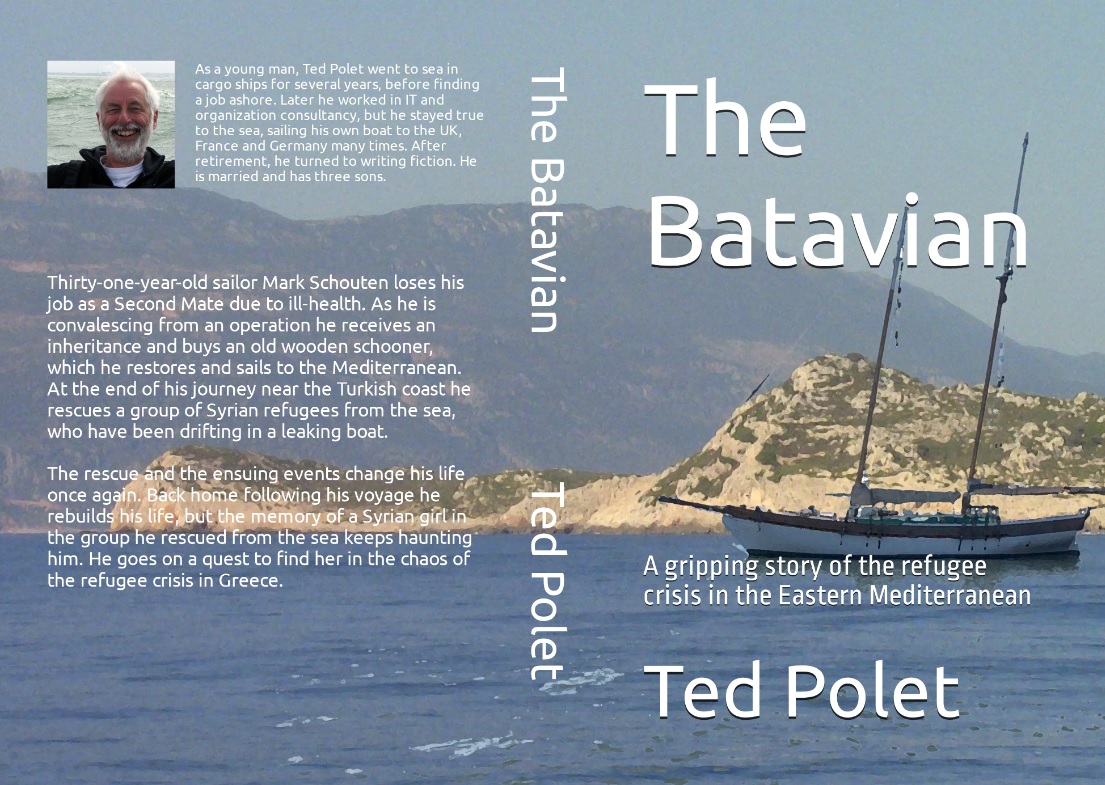
THE BATAVIAN (2019, revised 2023) is a gripping story of the refugee crisis in the Eastern Mediterranean.

Thirty-one-year-old sailor Mark Schouten loses his job as a Second Mate due to ill-health. As he is convalescing from an operation he receives an inheritance and buys an old wooden schooner, which he restores and sails to the Mediterranean. At the end of his journey near the Turkish coast he rescues a group of Syrian refugees from the sea, who have been drifting in a leaking boat.

The rescue and the ensuing events change his life once again. Back home following his voyage he rebuilds his life, but the memory of a Syrian girl in the group he rescued from the sea keeps haunting him. He goes on a quest to find her in the chaos of the refugee crisis in Greece.

click for extract from manuscript

Videotrailer for The Batavian: